Hazmat drayage is one of the highest-stakes moves in port logistics. A missing document, an unqualified driver, a mismatched placard, or a missed terminal procedure can stop a container at the gate, trigger a federal violation, or generate detention charges that wipe out the value of the shipment. For importers, freight brokers, and 3PLs moving dangerous goods through the Port of Long Beach, understanding the regulatory framework — and choosing a carrier that operates within it — is not optional.
This guide covers everything shippers need to know about hazmat container drayage at POLB: the nine DOT hazmat classifications, driver credential requirements, placard and IMDG compliance, shipper documentation obligations, terminal-specific procedures, the growing role of lithium battery shipments, and the most common mistakes that create costly problems. To arrange a hazmat dray from Long Beach with a qualified carrier, call Precision Worldwide Logistics at (714) 690-9344.
The Nine DOT Hazmat Classes: What You’re Actually Shipping
The U.S. Department of Transportation classifies all hazardous materials into nine classes under 49 CFR (Title 49 of the Code of Federal Regulations). Every hazmat container moving through a U.S. port is subject to this classification system — and the class determines the packaging, marking, placarding, and handling requirements that apply to the dray.
| Class | Category | Common Cargo Examples |
|---|---|---|
| Class 1 | Explosives | Ammunition, blasting agents, fireworks |
| Class 2 | Gases | Compressed gas, liquefied gas, flammable gas, toxic gas |
| Class 3 | Flammable Liquids | Gasoline, ethanol, acetone, paints and coatings |
| Class 4 | Flammable Solids | Matches, sulfur, metal powders, self-reactive substances |
| Class 5 | Oxidizers & Organic Peroxides | Ammonium nitrate, hydrogen peroxide, pool chemicals |
| Class 6 | Toxic & Infectious Substances | Pesticides, biohazardous material, toxic liquids |
| Class 7 | Radioactive Material | Medical isotopes, industrial gauges, nuclear fuel |
| Class 8 | Corrosives | Battery acid, hydrochloric acid, sodium hydroxide |
| Class 9 | Miscellaneous Hazmat | Lithium-ion batteries, EV battery packs, dry ice, magnetized materials, elevated-temperature cargo |
Each class has subdivisions and packing groups (Packing Group I, II, or III) that further calibrate the risk level and associated requirements. Packing Group I indicates the highest hazard, Packing Group III the lowest. The combination of DOT class, packing group, and UN number is what fully defines your shipment’s regulatory profile for the dray.
Class 9: The Most Common Hazmat at Port of Long Beach
Class 9 — miscellaneous hazardous materials — is by far the most frequently moved hazmat classification at the Port of Long Beach. The rapid expansion of electric vehicle manufacturing globally and the consumer electronics supply chain through Asia have made lithium-ion battery shipments a daily constant at LA/LB terminals. Dry ice for pharmaceutical cold chain, magnetized materials, and elevated-temperature cargo round out the Class 9 profile.
Precision Worldwide Logistics specializes in Class 9 hazmat drayage at Port of Long Beach. For Classes 1 through 8, we handle select shipments on a case-by-case basis — contact us with your UN number and commodity description to confirm capability before you book. See our full capability breakdown on the hazmat drayage service page.
TWIC and CDL-H: The Two Credentials That Qualify a Hazmat Driver
Two credentials separate a legally qualified hazmat drayage driver from one who cannot legally enter the terminal or transport your cargo. Any carrier moving a hazmat container at Port of Long Beach must have both — and as a shipper or broker, you have an obligation to understand what they mean.
TWIC — Transportation Worker Identification Credential
The Transportation Worker Identification Credential is issued by the Transportation Security Administration (TSA) following a federal security threat assessment that includes fingerprinting, a criminal background check, and identity verification. TWIC is required under the Maritime Transportation Security Act (MTSA) for unescorted access to secure areas of maritime facilities — including all POLB container terminals.
A driver without a TWIC card cannot enter a secure terminal zone unescorted to pick up a container. Some terminals allow escorted access for non-TWIC drivers, but this requires an escort at the terminal’s discretion, adds delay, and is not reliable. In practice, a driver without TWIC cannot be counted on to make a routine terminal pickup without disruption.
All Precision drivers are TWIC-cleared. When you book a hazmat dray with Precision, you are not relying on a spot-market driver whose credentials you cannot verify — you are booking a Precision employee, TWIC card in hand, dispatched from our La Mirada yard approximately 20 minutes from the port.
CDL-H — Hazmat Endorsement on the Commercial Driver’s License
The H endorsement (hazmat endorsement) is a federally mandated certification that must be added to a Commercial Driver’s License before a driver can legally transport hazardous materials. Obtaining the H endorsement requires:
- Passing a TSA Security Threat Assessment (separate from TWIC, though related)
- Passing a knowledge-based written examination covering 49 CFR hazmat regulations, emergency response procedures, and proper handling protocols
- Completing Entry-Level Driver Training (ELDT) from a provider listed on the FMCSA’s Training Provider Registry (required for new CDL holders)
- Renewal every five years, which requires re-testing and a new TSA security assessment
The H endorsement is not the same as general CDL experience. It specifically certifies that the driver has been trained on the federal hazmat regulations — placarding, documentation requirements, emergency response awareness, and proper cargo handling — and has cleared a federal background check.
Precision’s drivers hold current H endorsements. As an asset-based carrier, we employ our drivers directly and maintain their credentials as part of our compliance program. When you use a broker to source hazmat drayage capacity, the actual driver dispatched to your container may or may not hold a current H endorsement. You have no way to verify it until the driver arrives at the terminal — at which point a problem has already become a delay.
Placard Requirements and IMDG Code Compliance
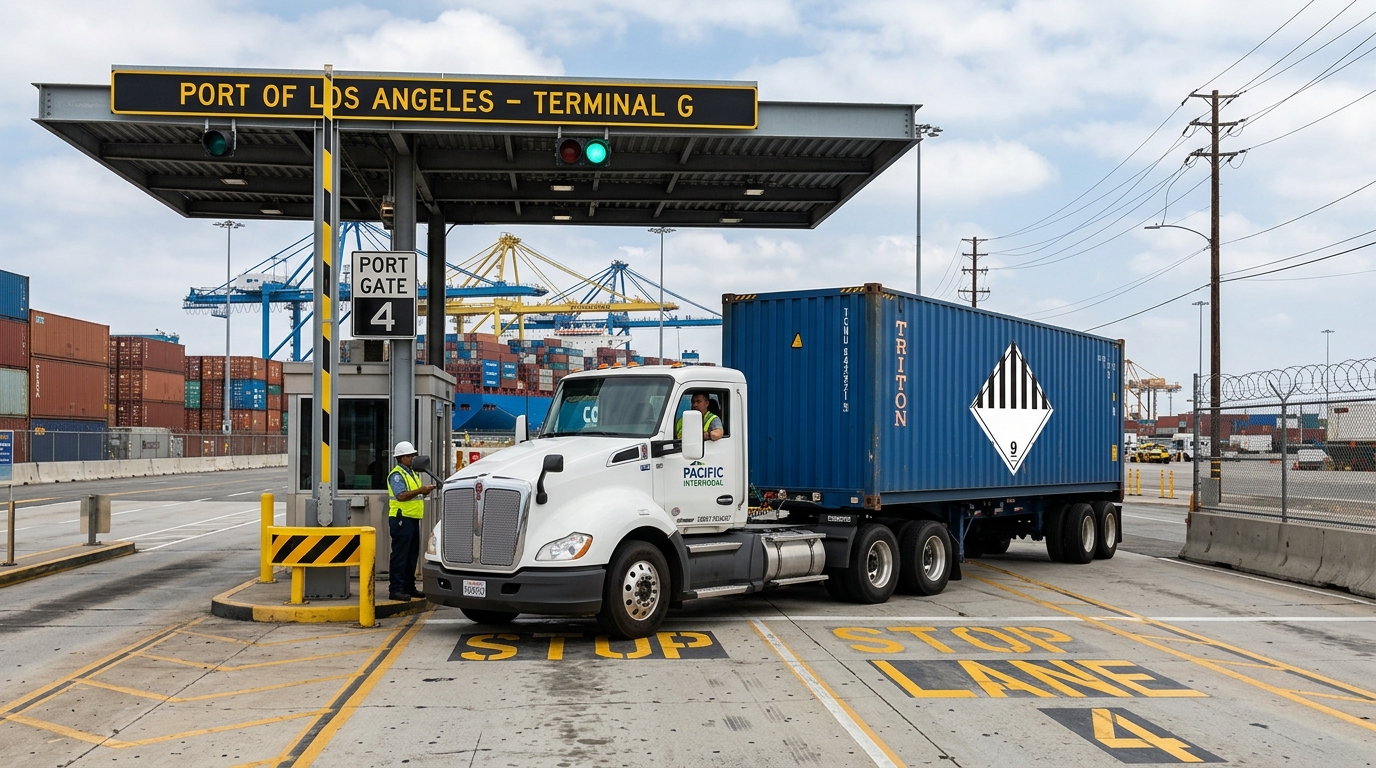
Hazmat containers moving through Port of Long Beach are subject to two overlapping regulatory frameworks: the DOT’s domestic hazmat regulations under 49 CFR, and the International Maritime Dangerous Goods (IMDG) Code that governs the ocean transport leg of the shipment.
DOT Placard Requirements
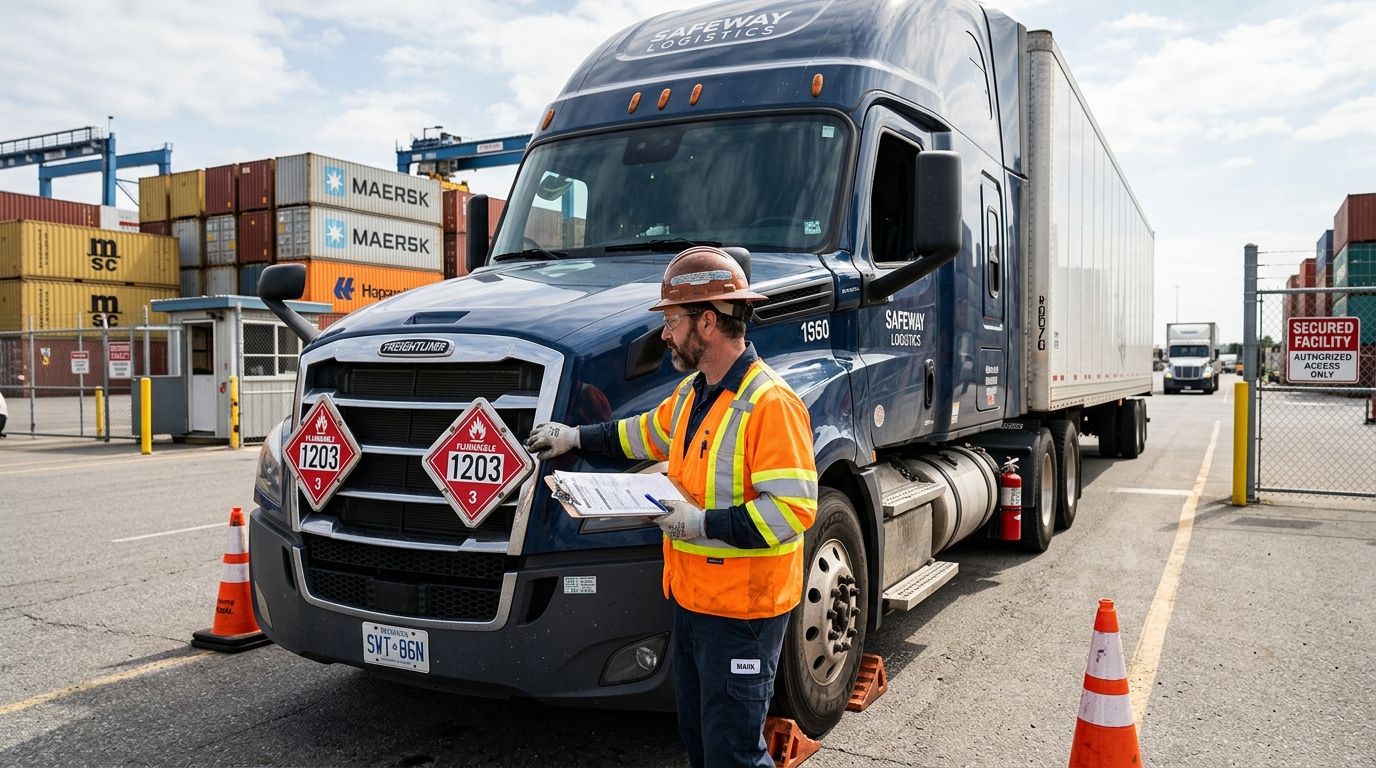
Under 49 CFR Part 172, any vehicle transporting hazardous materials in quantities above threshold amounts must display the correct DOT hazmat placard on all four sides of the trailer or chassis. The placard must match the hazmat class of the cargo — a mismatch between the placard and the shipping papers is a federal violation subject to significant fines. The specific placard design, color, and class number are prescribed by regulation and are not interchangeable.
The driver is responsible for confirming that the correct placards are present and properly displayed before departing the terminal. Precision’s drivers are trained to verify placard compliance at pickup — not after the container is already rolling. If a container is improperly placarded or the shipping papers do not match the declared class, the move stops until it is resolved. This is not bureaucratic caution; it is the regulatory requirement.
IMDG Code Compliance
The International Maritime Dangerous Goods Code — published by the International Maritime Organization (IMO) — governs the packaging, labeling, marking, stowage, and documentation of dangerous goods carried by sea. While the IMDG Code’s primary obligations fall on the shipper and ocean carrier, an inbound hazmat container at a marine terminal arrived under IMDG requirements. The Dangerous Goods Declaration (DGD) that accompanied the shipment on the vessel is part of the documentation that follows the container through the terminal.
A hazmat drayage driver picking up that container needs to understand the documentation structure — what the DGD is, what information it contains, and how it aligns with the driver’s shipping papers for the domestic leg. Mismatches between IMDG documentation and the 49 CFR domestic paperwork are a common friction point that experienced hazmat drayage drivers know how to navigate and, when necessary, escalate to the terminal’s hazmat coordinator before the container leaves the gate.
What Shippers Must Provide for Hazmat Drayage
As the shipper or consignee arranging a hazmat dray, you have documentation obligations that go beyond what is required for a standard container move. Failing to provide complete and accurate documentation is one of the most common sources of hazmat drayage delays. Have the following ready when booking and at the time of pickup.
Safety Data Sheet (SDS)
The Safety Data Sheet — formerly called the Material Safety Data Sheet (MSDS) — provides detailed information about the chemical composition, physical and health hazards, safe handling procedures, and emergency response measures for the hazardous material. While the SDS is primarily a safety and handling document rather than a transport document, your drayage carrier may request it — particularly for Class 1 through 8 commodities — to confirm their capability to handle the specific material and to prepare drivers for emergency response awareness.
UN Number and Proper Shipping Name
Every regulated hazardous material is assigned a UN number by the United Nations Committee of Experts on the Transport of Dangerous Goods. The UN number is required on shipping papers, container markings, and placards. Common examples relevant to Long Beach drayage include UN 3480 (lithium-ion batteries, standalone), UN 3481 (lithium-ion batteries packed with or in equipment), and UN 1845 (dry ice). Your shipping papers must include the proper shipping name (the official DOT/IMDG name for the material), hazard class, packing group, and UN number in the correct format.
Shipping Papers (Bill of Lading or Hazmat Manifest)
The driver must have hazmat shipping papers in the cab of the truck during transport. These papers must include the proper shipping name, hazard class and division, UN identification number, packing group, total quantity, and emergency response information (either a 24-hour emergency contact phone number or a reference to the Emergency Response Guidebook). Shipping papers that are incomplete, illegible, or do not match the container’s placards are a federal violation — and a reason for a carrier to refuse the move until corrected documentation is provided.
Emergency Response Information
49 CFR Part 172 requires that emergency response information — covering immediate hazards, fire and explosion risk, immediate health effects, and initial response measures — be accessible to the driver. This is typically satisfied by reference to the DOT Emergency Response Guidebook (ERG) guide number listed on the shipping papers, combined with a 24-hour emergency response telephone number. The CHEMTREC hotline (1-800-424-9300) is commonly used for this purpose. Confirm your shipping papers include a valid 24-hour emergency response number.
Terminal-Specific Hazmat Procedures at Port of Long Beach
Each of the major terminals at the Port of Long Beach handles hazmat containers through designated procedures that differ in detail from one terminal to the next. These are not cosmetic differences — a driver unfamiliar with a terminal’s hazmat lane routing, staging area location, or documentation checkpoint sequence can lose significant time or trigger a gate rejection.
The major POLB terminals handling hazmat containers include:
- Long Beach Container Terminal (LBCT) — Pier E, one of the most automated terminals on the West Coast, with specific hazmat staging procedures and documentation review at the in-gate
- International Transportation Services (ITS) — Pier G, handling significant volumes of Asian imports including Class 9 hazmat cargo
- Pacific Container Terminal (PCT) — Pier J, with its own in-gate hazmat review process and designated hazmat holding zones
- Total Terminal International (TTI) — Pier T, serving vessel calls with diverse hazmat cargo profiles
Precision’s drivers are regularly dispatched to all four of these terminals. Our 35 years of operating in the LA/LB port complex means our drivers understand where hazmat staging occurs, which documentation checkpoints to expect, how each terminal’s gate system processes hazmat releases, and how to resolve the routine exceptions that slow down less experienced operators. If your container requires a same-day pickup, ask about our Long Beach drayage capabilities and time-sensitive handling.
Lithium Battery Shipments: The Fastest-Growing Hazmat Category at Long Beach
Lithium-ion battery shipments have become one of the dominant hazmat categories at the Port of Long Beach — and the volume is accelerating. The convergence of global EV production scale-up, consumer electronics import volume, and domestic energy storage infrastructure buildout means that batteries classified under Class 9 are moving through POLB terminals in continuously increasing numbers.
Why Lithium Batteries Are Different
Lithium-ion batteries are classified as Class 9 hazmat because of their thermal runaway risk — the potential for an internal short circuit to trigger a self-sustaining exothermic reaction that generates intense heat and potentially fire. A damaged, defective, or improperly packaged lithium-ion battery can ignite without warning. At container scale, this risk is managed through strict IMDG packaging standards, UN certification testing requirements for the cells and battery packs, and specific stowage restrictions on vessels.
For the drayage move, the key compliance points are correct UN number identification (UN 3480 for standalone batteries, UN 3481 for batteries packed with or in equipment), proper shipping papers, correct Class 9 placards, and a driver who understands the emergency response protocol for a lithium battery thermal event. Precision’s hazmat-endorsed drivers are trained on these requirements.
EV Battery Packs and Overweight Combinations
Large-format EV battery modules — the type used in passenger vehicles, commercial trucks, and grid-scale energy storage systems — are also notable for their weight density. A 40-foot container loaded with EV battery modules for an automotive assembly plant can easily exceed 80,000 lbs GVW, triggering both the Class 9 hazmat requirements and a Caltrans overweight permit requirement. These dual-requirement loads demand a carrier that can handle both: a hazmat-endorsed, TWIC-cleared driver and a triaxle chassis with a valid overweight permit on file. Precision handles these overweight hazmat drayage moves — see our hazmat drayage service page for detail.
State of Charge Requirements
The IMDG Code specifies state-of-charge (SOC) limits for lithium-ion cells and batteries shipped as cargo. Large lithium-ion batteries (those with a Wh rating above specified thresholds) must be shipped at or below 30% SOC under current IMDG rules. Shippers are responsible for ensuring SOC compliance before the container is loaded. If SOC is out of compliance and detected at the terminal, the shipment can be rejected. Verify SOC compliance with your manufacturer or freight forwarder before the cargo is packed.
Common Mistakes Shippers Make with Hazmat Drayage
Most hazmat drayage problems are preventable. The same errors appear repeatedly across shippers who are new to hazmat or who underestimate the documentation burden of a dangerous goods move. Avoiding them starts with awareness.
1. Booking a Standard Carrier for a Hazmat Load
The most common and most serious mistake: booking a drayage carrier without confirming that the dispatched driver holds a current H endorsement and TWIC card. Not every carrier that accepts hazmat loads has qualified drivers for every move. When using a broker, you are particularly exposed — the broker may confirm carrier capability without verifying individual driver credentials for the specific dispatch. The result is a driver who arrives at the terminal legally unable to pick up the container. Book asset-based carriers with confirmed, in-house hazmat-endorsed drivers.
2. Providing Incomplete Shipping Papers
Shipping papers that are missing the proper shipping name, UN number, packing group, emergency response telephone number, or total quantity fail the 49 CFR requirements. A driver who accepts a load with non-compliant shipping papers is also in violation. Precision’s drivers are trained to review shipping papers before departing the terminal — if there is a deficiency, it gets flagged before the load moves, not after a roadside inspection.
3. Misidentifying the Hazmat Class or UN Number
Using the wrong UN number — or placing a shipment in the wrong hazmat class — generates a cascade of compliance problems: incorrect placards, incorrect emergency response references, and a mismatch with the vessel’s Dangerous Goods Declaration. This is particularly common with lithium battery shipments, where the difference between UN 3480 and UN 3481 (standalone batteries vs. batteries packed with equipment) is frequently confused. Verify with your freight forwarder that the UN number on the domestic shipping papers matches the IMDG DGD from the ocean leg.
4. Failing to Disclose Overweight Status on Hazmat Loads
A shipper who books a hazmat dray without disclosing that the container exceeds 80,000 lbs GVW puts the carrier in an impossible position: the driver cannot legally move the load without an overweight permit, and obtaining the permit at the terminal gate is not an option. The result is a missed pickup appointment, port detention charges, and a container sitting at the terminal while the permit is obtained. Disclose overweight status — and provide the gross container weight — at the time of booking.
5. Assuming All Class 9 Shipments Are Treated the Same
Class 9 covers a wide range of materials with different hazard profiles, packaging requirements, and handling procedures. Dry ice (UN 1845) has specific ventilation and asphyxiation awareness requirements. Large-format lithium batteries have state-of-charge restrictions. Magnetized materials (UN 2807) require specific distance-from-compass standards. Elevated-temperature cargo has thermal handling requirements. Do not assume that because a previous Class 9 shipment moved without issue, a different Class 9 commodity will be handled the same way. Communicate the specific commodity and UN number when booking.
Working with Precision on Hazmat Drayage at Long Beach
Precision Worldwide Logistics, Inc. is an asset-based drayage company headquartered in La Mirada, CA — approximately 20 minutes from the Port of Long Beach. We have operated at LA/LB terminals for 35 years. Our drivers are TWIC-cleared and hold current H endorsements on their CDLs. We own our tractors and chassis and dispatch our own drivers — there is no subcontracting to unknown operators when you book a hazmat move with Precision.
Our confirmed specialty is Class 9 hazmat drayage: lithium-ion batteries, EV battery packs, dry ice, magnetized materials, and elevated-temperature cargo. For Classes 1 through 8, we handle select shipments on a case-by-case basis — contact us with your UN number and commodity description to confirm before booking.
To get a hazmat drayage quote, have the following ready:
- UN number and proper shipping name
- DOT hazmat class (and packing group if known)
- Container size (20′, 40′, 40′ HC, 45′)
- Pickup terminal at POLB (LBCT, ITS, PCT, or TTI)
- Delivery destination and any appointment or delivery window requirements
- Gross container weight — required upfront if the load may be overweight
Call (714) 690-9344 or visit our hazmat drayage service page to request a quote. For information on standard drayage moves from Long Beach, see our Long Beach drayage hub page.
Frequently Asked Questions: Hazmat Drayage at Port of Long Beach
What hazmat classes does a drayage carrier need to handle at Port of Long Beach?
It depends on what you are shipping. The nine DOT hazmat classes cover everything from explosives (Class 1) through miscellaneous hazmat (Class 9). Class 9 — which includes lithium-ion batteries, EV battery packs, dry ice, and magnetized materials — is the most commonly moved hazmat classification at POLB today. Classes 3 (flammable liquids), 5 (oxidizers), and 8 (corrosives) also move through Long Beach in meaningful volumes. Any carrier handling these loads must have drivers with current hazmat endorsements (H endorsements) on their CDLs. Not every carrier is qualified for every class — always confirm the carrier’s capability for your specific commodity and UN number before booking.
What is a TWIC card and does my carrier’s driver need one?
Yes. The Transportation Worker Identification Credential is a TSA-issued federal ID required for unescorted access to secure areas of maritime facilities, including all container terminals at the Port of Long Beach. A driver without a valid TWIC card cannot enter the terminal unescorted to pick up a container. While some terminals permit escorted access for non-TWIC holders, this is unreliable for routine drayage operations and adds delay. Any carrier you use for Port of Long Beach drayage — hazmat or standard — should be able to confirm that the dispatched driver holds a current TWIC card. Asset-based carriers with in-house drivers can verify this; brokers sourcing spot capacity often cannot.
What documentation does a shipper need to provide for a hazmat drayage move?
At minimum, you must provide shipping papers that comply with 49 CFR Part 172, including the proper shipping name, hazard class and division, UN identification number, packing group, total quantity, and a 24-hour emergency response telephone number. For inbound ocean shipments, the Dangerous Goods Declaration (DGD) from the IMDG ocean leg should accompany the container documentation. A Safety Data Sheet (SDS) is advisable for any Class 1–8 shipment and may be required by the carrier to confirm commodity capability. If the container is also overweight, the carrier will need the gross container weight to obtain the appropriate Caltrans permit before pickup.
Why are lithium battery shipments considered hazmat?
Lithium-ion batteries are classified as Class 9 miscellaneous hazmat under both DOT (49 CFR) and IMDG Code regulations because of their thermal runaway risk — the potential for an internal short circuit to generate self-sustaining, intense heat and fire. A damaged or defective cell can ignite without an external ignition source, and once in thermal runaway, a lithium battery fire is extremely difficult to extinguish with conventional agents. The regulatory requirements — UN certification for packaging, state-of-charge limits for large batteries, Class 9 placards, and hazmat-endorsed drivers — exist to manage this risk during transport. Standalone batteries ship under UN 3480; batteries packed with or in equipment ship under UN 3481. Confirm the correct UN number with your freight forwarder before booking the dray.
What happens if my carrier doesn’t have a hazmat-endorsed driver at pickup?
The driver cannot legally transport the hazmat container, and the terminal will not release it to a non-qualified driver for a regulated hazmat move. The result is a missed pickup appointment, potential loss of the appointment slot, port detention charges accumulating on the container, and the need to re-dispatch a qualified driver — often on short notice and at additional cost. This scenario is avoidable by booking with an asset-based carrier that employs its own hazmat-endorsed, TWIC-cleared drivers and can confirm driver credential status at the time of booking. Do not rely on a broker’s assurance that “the driver will have the right credentials” without understanding how they are verifying that on the specific dispatch.