Logistics Experts Serving Port of Los Angeles and Port of Long Beach!

When a container comes off the vessel heavier than a standard chassis can legally carry, most drayage companies can’t touch it. Precision Worldwide Logistics can. We own our own triaxle chassis fleet, maintain the permits to operate on California’s overweight corridor, and have been moving heavy cargo out of the Port of Long Beach for 35 years. If your container is overweight, we handle the complexity so you don’t have to.

Need a quote now? Call (714) 690-9344 or use the form below.


Overweight Container Drayage at Port of Long Beach

Overweight drayage is the pickup and transport of intermodal containers whose cargo weight exceeds the legal limits for standard equipment — typically anything above 44,000–46,500 lbs. for a 40-foot container on a standard chassis. At the Port of Long Beach, overweight shipments are more common than many shippers realize, particularly in commodity categories like steel, paper, stone, and heavy machinery.

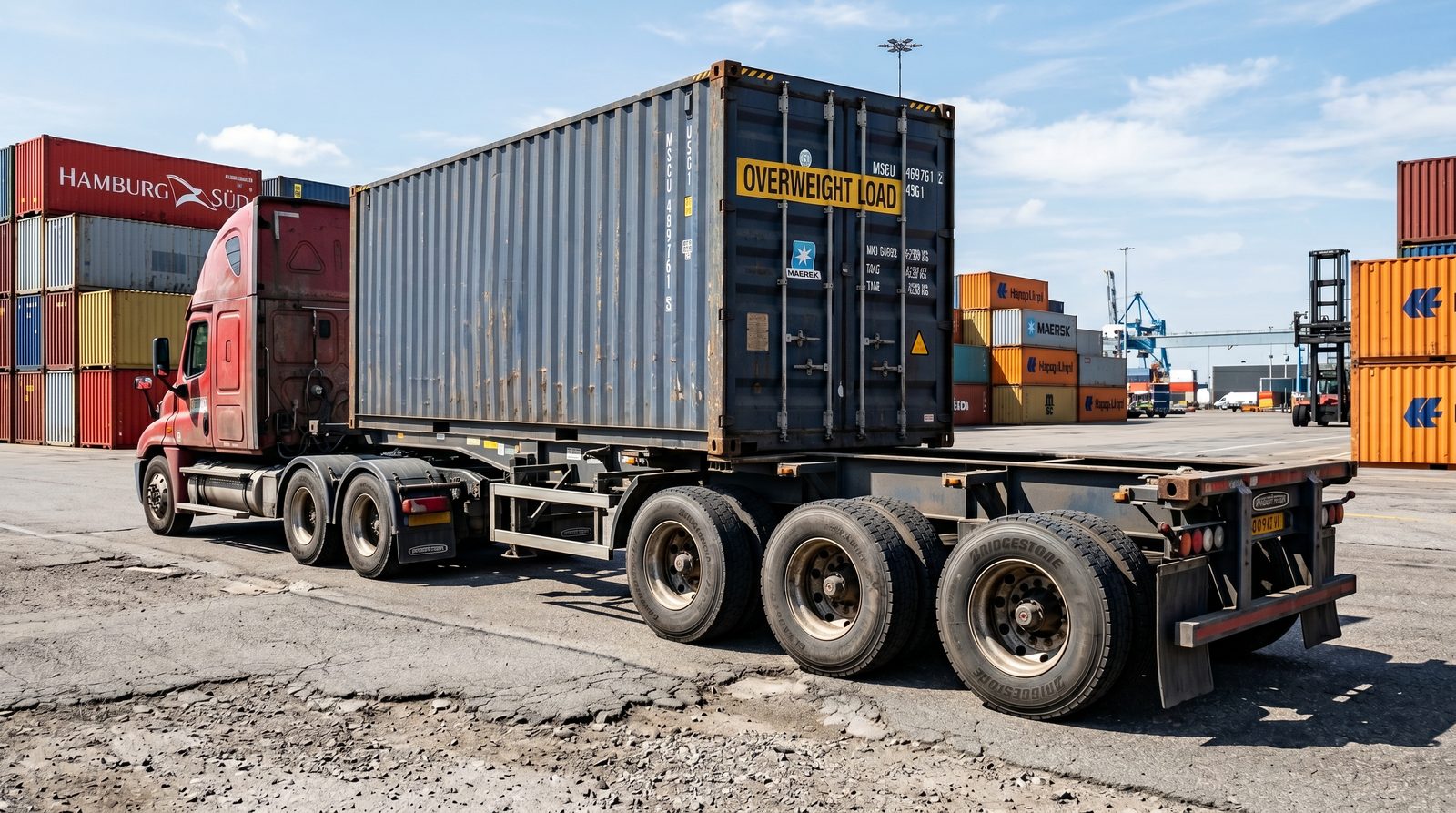
Handling these moves requires more than a willing driver. It requires the right chassis — specifically, a triaxle chassis capable of distributing the additional axle weight within legal per-axle limits — and in many cases a 4-axle drop-axle tractor. It also requires Caltrans overweight permits and, for moves within the designated corridor, permits from the City of Long Beach, City of Los Angeles, and Los Angeles County.

Precision Worldwide Logistics, Inc. is an asset-based drayage company based in La Mirada, CA — approximately 20 minutes from the Port of Long Beach. We own our triaxle chassis, employ TWIC-cleared drivers with decades of experience on port lanes, and manage the entire permitting process in-house. When your container clears customs heavy, we’re ready.

For a broader overview of our port operations, see our Long Beach drayage services.


What Makes a Container “Overweight” at Long Beach?

A container is considered overweight when its cargo weight — combined with the tractor, chassis, and container tare weight — pushes the combination above California’s legal gross weight limits or exceeds permissible per-axle weights. The legal threshold on U.S. interstates is a maximum gross vehicle weight of 80,000 lbs., but per-axle limits are often the binding constraint first.

Here’s how the weight tiers break down for the Port of Long Beach:

Container Size Cargo Weight Equipment Required
20-foot Up to 38,000 lbs. Standard steamship chassis + 3-axle tractor
20-foot 38,001 – 44,000 lbs. Triaxle slider chassis + 3-axle tractor
20-foot 44,001 – 58,000 lbs. Triaxle slider chassis + 4-axle tractor (overweight corridor + permits)
40-foot Up to 46,500 lbs. Standard steamship chassis + 3-axle tractor
40-foot 46,501 – 58,000 lbs. Triaxle slider chassis + 4-axle tractor (overweight corridor + permits)

Cargo weight may not exceed maximum container capacity weight. Gross weight figures include tractor, chassis, container, and cargo.

Violations carry serious consequences — heavy fines against the driver and the motor carrier, potential cargo delays, and liability exposure. Precision’s dispatch team reviews your cargo weight before every move and assigns the correct equipment from the start.


Our Triaxle Chassis Fleet

The single biggest bottleneck in overweight drayage isn’t paperwork — it’s equipment availability. Most drayage companies don’t own triaxle chassis. They rely on chassis pools or third-party providers, which means delays, availability gaps, and cost unpredictability.

Precision owns our triaxle chassis fleet. When your overweight container is ready for pickup, we’re not scrambling to locate a chassis from a pool. Our equipment is staged, maintained, and available.

What our triaxle chassis handle:

Owning our assets also means we control maintenance schedules, inspection compliance, and deployment priorities. There’s no chassis interchange delay and no third-party scheduling friction. You get a firm pickup window, not a “we’re waiting on equipment” update.


California Overweight Corridor & Permit Requirements

California maintains a designated overweight corridor near the Ports of Los Angeles and Long Beach — a roughly four-square-mile grid of local roads where properly permitted overweight trucks can legally operate. As of March 2022, Caltrans also opened Route 710 (the Gerald Desmond Bridge on I-710) to oversize and overweight loads under permit, significantly improving corridor connectivity for port drayage.

Permits required to operate in the overweight corridor:

Operating within the corridor requires three separate permits — one from the City of Los Angeles, one from the City of Long Beach, and one from the County of Los Angeles. Motor carriers purchase these annually, per truck. When a load must travel beyond the corridor — for example, to a warehouse in the Inland Empire — additional individual movement permits are required for each jurisdiction the load passes through.

For a single overweight move from Long Beach to a destination in San Bernardino County, a carrier may need five or more permits per truck, with permit costs that vary by jurisdiction and route — contact us for a quote specific to your move.

Who handles permitting for Precision moves?

We do. Our operations team manages the full permitting process — corridor permits, route-specific permits, and any special conditions. You don’t need to engage a separate permit agency or track compliance across multiple jurisdictions. We handle it as part of the move.

Caltrans Sea Container Permit: For 4-axle tractor and 3-axle trailer combinations transporting intermodal containers on California state highways near the Port of Long Beach, Caltrans issues a specific Sea Container Permit. Precision maintains these permits for our eligible fleet configurations.


Common Cargo Types Requiring Overweight Drayage

Overweight containers arrive at Port of Long Beach across a wide range of commodity categories. Some of the most common we handle:

Steel Coils and Metal Products
Steel coils are one of the densest cargo types in intermodal shipping. A single 20-foot container loaded with steel coils can easily hit or exceed 44,000–55,000 lbs. of cargo weight, requiring triaxle chassis and corridor permits in virtually every case.

Industrial Machinery and Equipment
CNC machines, presses, compressors, generators, and other industrial equipment are frequently shipped in standard containers but arrive well above the 44,000-lb. threshold. These loads often require blocking and bracing inside the container in addition to overweight chassis.

Paper and Pulp Rolls
Paper rolls and pulp bales from overseas mills are dense and compact, with full containers routinely exceeding standard weight limits. This is one of the most consistent overweight cargo categories at Long Beach.

Stone, Granite, and Tile
Natural stone, granite slabs, and ceramic tile shipments are extremely dense. Containers of these products regularly require triaxle chassis and, depending on total weight, 4-axle tractors with corridor permits.

Construction Equipment
Excavator attachments, hydraulic components, cast iron parts, and similar construction-related imports frequently arrive overweight. Component weights can be substantial even when equipment arrives partially disassembled.

Batteries and Energy Storage
As electric vehicle and grid storage shipments have grown, heavy battery pack assemblies have become an increasingly common overweight cargo category at Long Beach. These loads also carry hazmat considerations our TWIC-cleared drivers are trained to handle.

OOG and Oversize Containers
Out-of-gauge (OOG) shipments — cargo that exceeds standard container dimensions — may overlap with overweight requirements. If your load is both oversized and heavy, Precision coordinates the correct equipment and permits for both conditions.


Overweight Drayage vs. Transloading: Which Is Right for You?

When a container arrives overweight, shippers face a choice: move it as-is under an overweight permit arrangement, or transload — unloading a portion of the cargo into a second trailer to bring the original container within legal weight limits.

Both are legitimate options, and Precision offers both. Here’s how to think about the decision:

Choose overweight drayage when:
– Your delivery destination is within or near the overweight corridor
– The cargo cannot be safely separated (steel coils, machinery, stone)
– Speed matters — transloading adds handling time and a second move
– The commodity is high-value and minimizing touch points is a priority

Choose transloading when:
– The destination is far from the port corridor, where multi-jurisdiction permit costs accumulate significantly
– The cargo is safely divisible — palletized goods, bagged product, boxes
– Total landed cost with transloading is lower than permit and specialized equipment costs
– You have downstream distribution needs that make splitting the load practical anyway

Overweight drayage costs more than a standard move due to permit fees, specialized equipment, and corridor routing. Transloading introduces additional labor and handling costs but avoids permit complexity on long-haul routes. Contact Precision for a side-by-side cost comparison for your specific move.

Precision’s operations team will give you an honest recommendation based on your cargo type, weight, destination, and timeline. If transloading makes more sense for your move, we offer that too — learn more about our transloading services.

For a deeper look at the tradeoffs, read our overweight container drayage guide.


Why Choose Precision for Overweight Drayage Long Beach?

Asset-Based Operations — No Third-Party Equipment Delays
Precision owns our triaxle chassis fleet. We don’t depend on chassis pools or brokered equipment. When you book an overweight pickup, the chassis is ours — available, compliant, and staged for the move.

In-House Permit Handling
We manage overweight corridor permits, Caltrans Sea Container Permits, and any individual movement permits required for your route. Our operations team knows the permit requirements for jurisdictions across Southern California and handles the administrative process as part of every move.

35 Years at Port of Long Beach
Precision has operated in the Los Angeles and Long Beach port market for over three decades. Our drivers know the terminals, the lanes, the weigh station locations, and the corridor routes. There’s no learning curve on your freight.

TWIC-Cleared Drivers
All Precision drivers hold Transportation Worker Identification Credentials (TWIC), required for unescorted access to secure port areas. We’re credentialed and ready for port pickup without administrative delays.

Experienced with Complex Cargo
From steel coils to precision machinery to battery assemblies, Precision’s team has seen the full range of overweight cargo categories. We understand the blocking, bracing, and weight distribution considerations that prevent damage and compliance issues.

La Mirada Location — 20 Minutes from the Port
Our terminal in La Mirada, CA positions us close to the Port of Long Beach. Shorter deadhead distance means faster availability and competitive rates.

If timing is critical, ask about our same-day pickup capability for urgent overweight moves.


Get an Overweight Drayage Quote for Long Beach

Overweight moves require the right information upfront. When you contact Precision, have the following ready:

Our team will confirm equipment availability, determine permit requirements for your route, and provide a firm quote — no surprises.

Call (714) 690-9344 — available during business hours for immediate quotes on overweight drayage from Port of Long Beach.

Or submit the contact form below and a member of our operations team will respond promptly.


Frequently Asked Questions

H3: What weight qualifies as overweight for drayage at Port of Long Beach?

A container is generally considered overweight when its cargo weight exceeds the capacity of a standard steamship chassis — approximately 44,000–46,500 lbs. for a 40-foot container. At that point, a triaxle chassis is required. For cargo weights above 47,000 lbs. (for 20-foot containers) or 46,501 lbs. (for 40-foot containers), a 4-axle drop-axle tractor is required in addition to the triaxle chassis, and the move must be conducted within the overweight corridor with the appropriate permits. The absolute ceiling for permitted overweight container moves in the corridor is approximately 58,000 lbs. of cargo weight.

H3: Do you own your own triaxle chassis?

Yes. Precision Worldwide Logistics owns our triaxle chassis fleet — we do not rely on chassis pools or third-party equipment providers for overweight moves. This means we control availability, maintenance, and scheduling. When you book an overweight pickup with Precision, we confirm the chassis is available before committing to the move, not after.

H3: Who handles the overweight permits?

Precision handles all overweight permitting as part of the drayage move. This includes annual corridor permits for the City of Long Beach, City of Los Angeles, and Los Angeles County, as well as Caltrans Sea Container Permits for 4-axle tractor configurations. For moves beyond the corridor, we manage individual movement permits for each jurisdiction along the route. You don’t need to engage a separate permit service or track permit compliance yourself.

H3: How much more does overweight drayage cost vs. standard?

Overweight drayage at Port of Long Beach costs more than a standard move due to triaxle chassis requirements, 4-axle tractor needs for the heaviest loads, permit fees across multiple jurisdictions, and slower corridor routing. Precision provides transparent, itemized quotes so you understand exactly what drives the cost on your specific move. Call us for a firm quote.

H3: What is the I-710 overweight corridor?

The overweight corridor is a roughly four-square-mile network of local roads surrounding the Ports of Long Beach and Los Angeles where properly permitted overweight trucks can legally operate. As of March 2022, Caltrans also opened Route 710 (I-710, the Gerald Desmond Bridge approach) to oversize and overweight loads under permit, improving access to and from the corridor. Moves within the corridor require three annual permits (City of LA, City of Long Beach, LA County). Moves that extend beyond the corridor require additional permits for each jurisdiction the load travels through.

H3: Is transloading a better option than overweight drayage?

It depends on your cargo type, destination, and cost tolerance. Transloading — unloading a portion of the container into a second truck to bring the original container within legal weight limits — makes sense when your destination is far from the port (where multi-jurisdiction permit costs accumulate) or when the cargo is safely divisible. Overweight drayage is the better choice when the cargo cannot be separated (steel coils, machinery, stone), when minimizing cargo handling is a priority, or when the delivery point is within or near the overweight corridor. Precision offers both services and will recommend the right approach for your specific shipment. Learn more about our transloading services.


Precision Worldwide Logistics, Inc. | La Mirada, CA | (714) 690-9344
Asset-based drayage — triaxle chassis owned, permits handled, 35 years at the Port of Long Beach.


[JSON-LD SCHEMA]

Paste this in the <head> section of the page or via a WordPress SEO plugin’s schema field (e.g., Yoast or RankMath custom schema):

<script type="application/ld+json">
[
  {
    "@context": "https://schema.org",
    "@type": "FAQPage",
    "mainEntity": [
      {
        "@type": "Question",
        "name": "What weight qualifies as overweight for drayage at Port of Long Beach?",
        "acceptedAnswer": {
          "@type": "Answer",
          "text": "A container is generally considered overweight when its cargo weight exceeds the capacity of a standard steamship chassis — approximately 44,000–46,500 lbs. for a 40-foot container. At that point, a triaxle chassis is required. For cargo weights above 47,000 lbs. (for 20-foot containers) or 46,501 lbs. (for 40-foot containers), a 4-axle drop-axle tractor is required in addition to the triaxle chassis, and the move must be conducted within the overweight corridor with the appropriate permits. The absolute ceiling for permitted overweight container moves in the corridor is approximately 58,000 lbs. of cargo weight."
        }
      },
      {
        "@type": "Question",
        "name": "Do you own your own triaxle chassis?",
        "acceptedAnswer": {
          "@type": "Answer",
          "text": "Yes. Precision Worldwide Logistics owns our triaxle chassis fleet — we do not rely on chassis pools or third-party equipment providers for overweight moves. This means we control availability, maintenance, and scheduling. When you book an overweight pickup with Precision, we confirm the chassis is available before committing to the move, not after."
        }
      },
      {
        "@type": "Question",
        "name": "Who handles the overweight permits?",
        "acceptedAnswer": {
          "@type": "Answer",
          "text": "Precision handles all overweight permitting as part of the drayage move. This includes annual corridor permits for the City of Long Beach, City of Los Angeles, and Los Angeles County, as well as Caltrans Sea Container Permits for 4-axle tractor configurations. For moves beyond the corridor, we manage individual movement permits for each jurisdiction along the route. You don't need to engage a separate permit service or track permit compliance yourself."
        }
      },
      {
        "@type": "Question",
        "name": "How much more does overweight drayage cost vs. standard?",
        "acceptedAnswer": {
          "@type": "Answer",
          "text": "Overweight drayage costs more than a standard move due to triaxle chassis requirements, 4-axle tractor needs, permit fees across multiple jurisdictions, and slower corridor routing. Precision provides transparent, itemized quotes so you understand exactly what drives the cost. Call us for a firm quote."
        }
      },
      {
        "@type": "Question",
        "name": "What is the I-710 overweight corridor?",
        "acceptedAnswer": {
          "@type": "Answer",
          "text": "The overweight corridor is a roughly four-square-mile network of local roads surrounding the Ports of Long Beach and Los Angeles where properly permitted overweight trucks can legally operate. As of March 2022, Caltrans also opened Route 710 (I-710, the Gerald Desmond Bridge approach) to oversize and overweight loads under permit, improving access to and from the corridor. Moves within the corridor require three annual permits (City of LA, City of Long Beach, LA County). Moves that extend beyond the corridor require additional permits for each jurisdiction the load travels through."
        }
      },
      {
        "@type": "Question",
        "name": "Is transloading a better option than overweight drayage?",
        "acceptedAnswer": {
          "@type": "Answer",
          "text": "It depends on your cargo type, destination, and cost tolerance. Transloading — unloading a portion of the container into a second truck to bring the original container within legal weight limits — makes sense when your destination is far from the port or when the cargo is safely divisible. Overweight drayage is the better choice when the cargo cannot be separated (steel coils, machinery, stone), when minimizing cargo handling is a priority, or when the delivery point is within or near the overweight corridor. Precision Worldwide Logistics offers both services and will recommend the right approach for your specific shipment."
        }
      }
    ]
  },
  {
    "@context": "https://schema.org",
    "@type": "Service",
    "name": "Overweight Container Drayage Long Beach",
    "description": "Asset-based overweight container drayage at the Port of Long Beach. Precision Worldwide Logistics owns triaxle chassis, handles Caltrans and corridor permits, and serves all overweight cargo types including steel coils, machinery, stone, and paper. Serving the Port of Long Beach for over 35 years.",
    "provider": {
      "@type": "Organization",
      "name": "Precision Worldwide Logistics, Inc.",
      "url": "https://www.precisioninc.com",
      "telephone": "+17146909344",
      "address": {
        "@type": "PostalAddress",
        "addressLocality": "La Mirada",
        "addressRegion": "CA",
        "addressCountry": "US"
      }
    },
    "areaServed": {
      "@type": "Place",
      "name": "Port of Long Beach",
      "address": {
        "@type": "PostalAddress",
        "addressLocality": "Long Beach",
        "addressRegion": "CA",
        "addressCountry": "US"
      }
    },
    "serviceType": "Overweight Drayage",
    "url": "https://www.precisioninc.com/services/drayage/long-beach/overweight/"
  }
]
</script>

[ALT TEXT RECOMMENDATIONS]

Image 1 — Triaxle chassis at port terminal

Precision Worldwide Logistics triaxle chassis staged at Port of Long Beach terminal for overweight container pickup

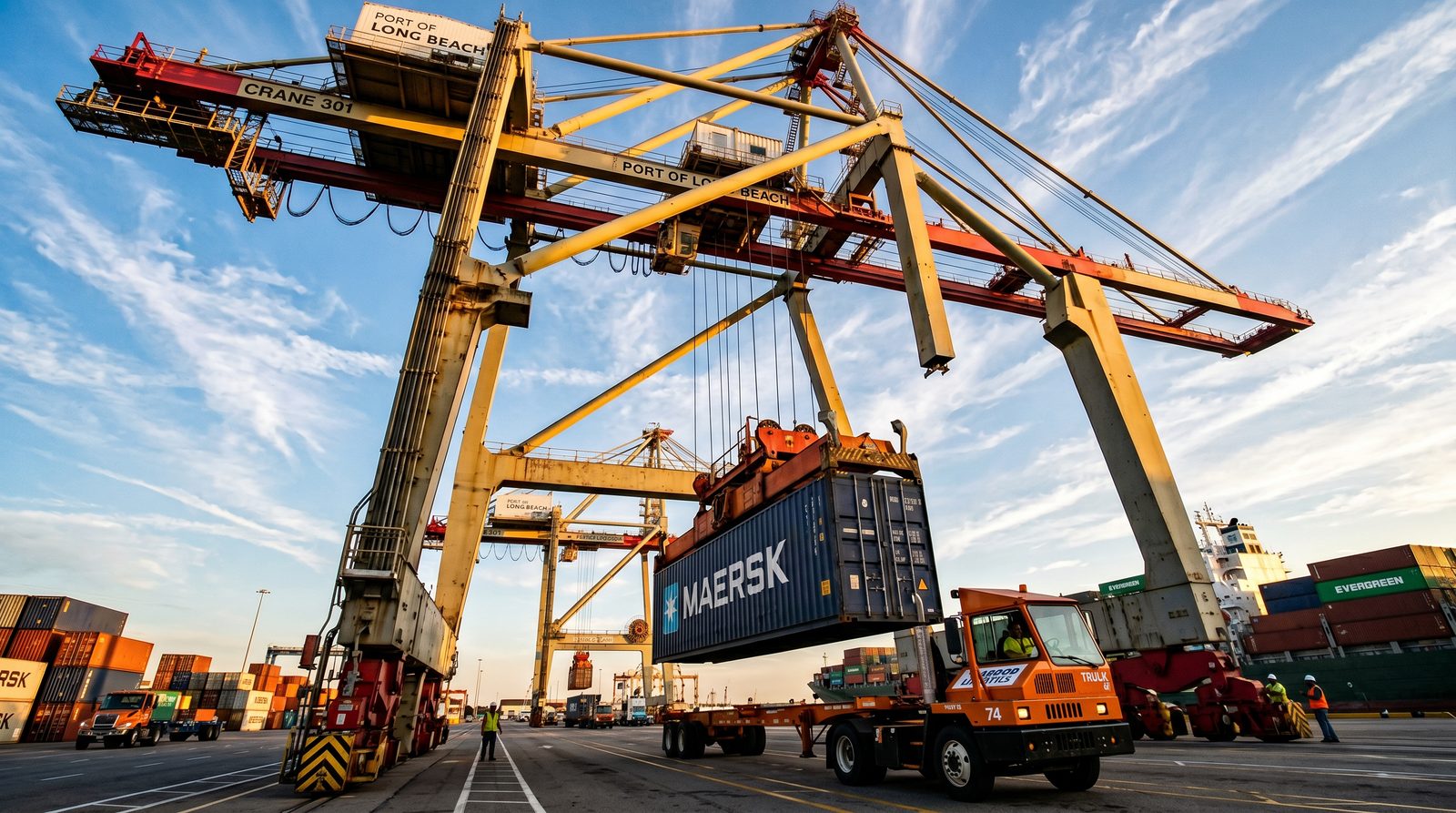
Image 2 — Heavy container being loaded (steel coils or machinery)

Overweight container loaded with steel coils being drayaged from Port of Long Beach via triaxle chassis

Image 3 — I-710 corridor / aerial view of Long Beach port area

Aerial view of I-710 overweight corridor near Port of Long Beach used for permitted heavy container drayage

Get an Overweight Drayage Quote

Call (714) 690-9344 or use the form on this page to request a quote for your overweight container.