Moving freight efficiently from ship to shelf in Southern California takes more than location—it takes coordination. The ports of Los Angeles and Long Beach handle close to half of the nation’s containerized imports, creating one of the most complex and vital logistics networks in the country. You gain a true advantage when your port-to-distribution strategy reduces dwell time, lowers drayage costs, and maintains product flow without disruptions.
You connect to a vast system that begins the moment a vessel unloads and continues through storage, transloading, and inland transport. Every step influences delivery speed, cost, and inventory position. By understanding the flow architecture across Southern California’s corridors, you can make informed decisions that keep your goods moving smoothly through every checkpoint.
At the center of this process, Precision Worldwide Logistics, Inc. in La Mirada brings dependable control through its asset-based approach. With integrated drayage, warehousing, fulfillment, and over-the-road transportation, you can align each segment of your supply chain under one trusted partner—ensuring efficiency from the port to your final destination.
System Boundaries from Vessel Discharge to Inland Handoffs
Cargo movement in Southern California depends on several linked systems that start when containers leave the vessel and end when they reach inland facilities. Each step—terminal handling, trucking coordination, and handoffs to storage or rail—requires attention to timing, equipment availability, and carrier policy to prevent costly delays.
Port Discharge Sequencing and Container Availability
Vessel discharge follows a structured plan driven by ship size, berth schedule, and yard space. Large ships may take 24–48 hours to unload, while smaller vessels finish in roughly half that time. Terminals handle containers in priority order based on cargo type, consignee, and customs status.
Availability also depends on where your container sits in the stack. Containers buried under others wait longer before release. Automated terminals with digital scheduling release freight sooner than those using manual systems. During high-volume periods, vessel bunching and limited yard capacity can extend availability times.
You can track your container’s progress through terminal portals that show discharge updates and customs clearance. Consistent monitoring helps you coordinate truck appointments and prevent demurrage once free time—usually three to five days—begins.
Drayage Initiation and Terminal Release Constraints
Drayage starts only after your container clears customs and receives a release authorization from the carrier. Without those two steps, no driver can pick up the load. Terminals require appointment slots that open a few days before the container becomes available, and you need to reserve early to avoid missing pickup windows.
Appointment congestion is common between 7 a.m. and 10 a.m.. You may need to select off-peak hours to maintain schedule reliability. Even with a valid appointment, gate queues can last 30 to 90 minutes during busy cycles.
To move efficiently, coordinate with a drayage provider that manages real-time dispatch and access to chassis equipment. Having equipment available prevents idle trucks and limits per diem costs when containers linger past the allowed storage time.
Transfer Points Between Transport and Storage
After leaving the terminal, your container may move through one or more handoff points before reaching its final warehouse. The main types are:
| Transfer Type | Description | Typical Location | Key Benefit |
|---|---|---|---|
| Direct Delivery | Container goes straight to warehouse | Near or inland distribution center | Simplest routing |
| Near-Dock Staging | Short-term parking on chassis | Within 1–2 miles of port | Reduces terminal congestion |
| Transload Facility | Cargo transferred to domestic trailer | Carson, La Mirada, Inland Empire | Frees container faster |
You choose the method based on warehouse readiness, distance, and inventory priorities. If your warehouse cannot unload right away, staging yards or cross-dock services limit storage charges and maintain control over delivery timing. Efficient coordination at each point keeps equipment circulating and supports steady throughput from the port to inland distribution centers.
Flow Architecture Across Southern California Corridors
You manage the movement of goods through one of the most complex and high-volume logistics regions in the world. Corridors link deep-water ports to inland hubs by rail and highway, shaping how freight flows and how space and infrastructure are used to handle immense cargo demand efficiently.
Routing from Port of Los Angeles and Port of Long Beach
You rely on two primary gateways—the Port of Los Angeles and the Port of Long Beach—which together handle nearly half of the country’s seaborne cargo. Ships unload containers directly onto rail lines and trucks that feed into established freight corridors. Major routes include the I-710 corridor, I-110, and the Alameda Corridor rail line connecting to the national rail network.
You can move cargo inland within hours due to intermodal connections near the docks. Short-haul drayage trucks handle transfers between marine terminals and nearby transload facilities. These facilities break down international containers for domestic distribution, improving efficiency when redirecting inventory to regional centers. Reliable schedules and direct terminal access reduce delays and energy costs.
You must plan for congestion management and environmental compliance. The region prioritizes lane management strategies and zero-emission zones along major arteries to balance freight flow with urban air quality needs.
Inland Distribution Clusters and Warehouse Density
Your logistics reach extends beyond the coastal ports into inland hubs where warehouse density and land availability enhance throughput. The Inland Empire, covering parts of Riverside and San Bernardino Counties, holds the majority of Southern California’s modern distribution centers. These spaces provide large floor plates, advanced automation, and proximity to rail spurs and interstates.
You see warehouse developments concentrated near I-10, I-15, and SR-60, forming a network of high-volume logistics zones. Location patterns follow access to labor, population centers, and cross-state freight routes. Clusters near Ontario, Fontana, and Moreno Valley serve as consolidation points before product redistribution nationwide.
The following factors define inland logistics performance:
| Factor | Description |
|---|---|
| Space utilization | High ceiling clearances and multi-tenant layouts to manage varied cargo types |
| Transportation links | Proximity to regional rail lines and interstates for faster outbound shipping |
| Zoning policies | Growth concentrated in industrial corridors with streamlined permitting |
Rail Versus Truck Modal Divergence
You balance between rail and truck modes depending on shipment distance, speed, and cost. Rail dominates long-haul transport, especially along the BNSF and Union Pacific transcontinental routes stretching from Southern California to the Midwest. Nearly all segments between the region and Chicago operate on double-track or greater, allowing continuous freight movement.
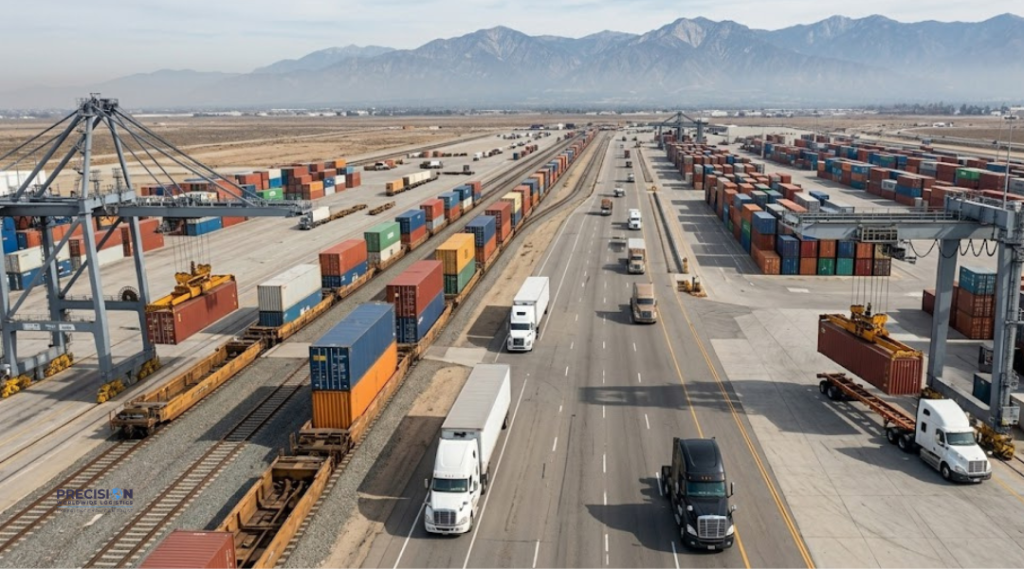
Trucking remains essential for short-haul and last-mile delivery. You rely on regional carriers to connect distribution centers with retail hubs across Los Angeles, San Diego, and beyond. Fleet operators increasingly use electric or hybrid trucks in local zones to meet environmental goals.
Rail reduces per-unit emissions and congestion, while trucks provide flexibility. You often use intermodal hubs where containers switch modes with minimal handling, improving asset utilization. This blended approach keeps supply chains resilient despite fluctuations in port volumes or highway delays.
Coordination Mechanics Between Drayage, Transloading, Storage
Efficient coordination between drayage, transloading, and storage ensures freight moves quickly from the port to inland distribution points. You manage space, scheduling, and equipment performance to avoid container dwell, congestion, and detention charges. Each decision—from unloading method to yard setup—directly impacts cost and delivery speed.
Container Strip Versus Live Unload Decisions
You choose between container stripping and live unloading based on shipment size, facility capacity, and timing. In a container strip, freight is removed upon arrival and palletized for later movement. This method supports flexibility when inbound timing varies or storage buffers are needed. It works best when you have available dock space and staff ready to reconfigure loads efficiently.
A live unload keeps the container on the chassis during unloading. It limits handling steps but requires labor and dock availability at the right time. This method avoids storage and demurrage fees if the yard is congested. However, delays during live unloading can tie up chassis and slow fleet turnover. You balance both methods based on volume flow, yard congestion, and customer delivery windows.
Key factors to monitor:
| Factor | Live Unload | Container Strip |
|---|---|---|
| Time per move | Shorter | Longer |
| Space needed | Less | More |
| Flexibility | Low | High |
| Chassis use | Continuous | Freed after unload |
Cross-Docking Versus Staged Inventory Positioning
When cargo leaves the port, your choice between cross-docking and staged storage drives throughput speed. Cross-docking moves incoming goods directly to outbound trailers, reducing storage time and labor. This strategy fits predictable, high-volume retail and e-commerce shipments with tight delivery schedules.
Staged inventory positioning builds a short-term buffer in the warehouse. You hold freight until orders come in or downstream capacity opens. This approach improves order-fill accuracy and absorbs port schedule fluctuations. In Southern California’s high-demand environment, combining both—using a mix of live cross-dock and staged zones—helps balance quick turnover with reliability.
To optimize flow, maintain synchronized visibility between port drayage schedules, warehouse dock times, and carrier appointments through transportation management software or EDI links.
Equipment Availability and Yard Throughput Limits
You depend on chassis, yard tractors, and dock doors to maintain continuous freight movement. Limited equipment creates bottlenecks, especially when vessel bunching floods terminals with imports. Monitoring equipment rotation helps prevent idle containers and avoid the cost of daily chassis rentals or extended demurrage.
Yard throughput also relies on organized traffic lanes, clear signage, and accurate gate timing. An uncoordinated yard slows turn times and complicates drayage scheduling. Using a yard management system (YMS) improves visibility of container status and location, letting you pre-stage high-priority loads.
To stay efficient:
- Track equipment usage daily.
- Communicate real-time constraints to dray carriers.
- Rotate assets promptly after unloading.
This structured coordination improves flow and reduces idle time at every handoff point.
Tradeoffs Between Speed, Cost, and Inventory Positioning
Balancing rapid cargo flow, logistics costs, and inventory placement defines the efficiency of your Southern California supply chain. The key is finding a practical middle ground between faster delivery promises, cost-effective operations, and inventory availability near ports or distribution centers.
Transit Time Compression Versus Cost Escalation
When you push for shorter transit times from port to distribution center, costs often rise. Expedited trucking and premium drayage rates quickly add up, especially when congestion or container backlogs tighten carrier capacity. You may also face added labor and coordination costs to meet reduced delivery windows.
Faster turnaround can improve customer satisfaction, but paying for speed is only worthwhile when demand or service expectations justify it. In Southern California, this tradeoff is pronounced due to high freight volumes through Los Angeles and Long Beach.
A few practical ways to balance these pressures include:
- Combining shipments into optimized loads.
- Using flexible transport modes such as intermodal rail for longer hauls.
- Staggering pickup schedules to avoid peak-hour port fees.
By measuring transit savings against real cost increases, you can determine whether time gains create measurable value or simply inflate expenses.
Storage Deferral Versus Immediate Distribution
Deciding whether to hold freight near ports or move it inland affects both cost and responsiveness. Storing goods at a port-adjacent facility can defer full-scale distribution until demand signals are clear. This option saves on inland transport and reduces the risk of overstocking distant warehouses.
However, keeping too much cargo in temporary storage can tie up capital and expose you to higher per‑square‑foot warehouse rates. Immediate distribution, by contrast, pushes inventory closer to retail or manufacturing points but locks you into earlier transportation commitments.
Many importers find balance through cross-docking or short‑term transloading. These methods keep goods moving without lengthy storage, enabling faster deployment once destination orders are ready. The most effective strategy often mixes deferred and immediate flows based on seasonality and channel priorities.
Risk Exposure to Demurrage and Detention
The longer containers sit idle at the port or in drayage queues, the higher your exposure to demurrage and detention fees. These charges accumulate when equipment or cargo isn’t moved within specified time limits. In congested areas like Southern California, even minor delays can quickly escalate into thousands of dollars.
Closely tracking container dwell times and coordinating gate appointments helps reduce this risk. Real‑time visibility software and carrier alerts allow you to plan pickups before free time expires.
Additionally, maintaining nearby staging space or pre‑cleared storage areas helps you pivot quickly when vessels arrive early or late. Paying attention to these timing details not only saves cost but also protects your schedule consistency across the distribution network.
Precision Worldwide Logistics, Inc. Within Regional Flow Constraints
You operate in a market shaped by port congestion, high freight volumes, and limited yard space. Precision Worldwide Logistics, Inc. strengthens your supply chain by using its own transportation assets, short-haul efficiency, and close access to the Port of Los Angeles to reduce downtime and variability across routes.
Asset-Based Drayage Control Under Port Variability
You face frequent challenges from vessel schedule changes and gate delays at Southern California ports. Precision Worldwide uses its asset-based drayage model to reduce this uncertainty. Because the company owns its trucks, chassis, and containers, you gain steady capacity without waiting for brokers or shared chassis pools.
This model helps control both pickup and return timing. By managing its own yard, Precision can preload or stage containers to fit your receiving schedules. You can expect faster turns and fewer demurrage charges, especially when ports operate under peak workloads.
| Key Advantage | Operational Impact |
|---|---|
| Owned Fleet | Reliable truck and chassis availability |
| Local Dispatch | Shorter dispatch-to-port response time |
| Dedicated Yard | Flexible container staging and drop options |
Using this structure, you keep cargo moving even when external conditions shift unexpectedly.
Transloading Alignment with Warehouse Proximity
You gain efficiency when transloading facilities sit close to your distribution warehouses. Precision Worldwide’s site near the Los Angeles and Long Beach corridor allows direct coordination between inbound containers and outbound domestic shipments. Shipments can move from port to warehouse in under an hour, minimizing idle time.
Their cross-dock and transload setups support both palletized and floor-loaded cargo. You benefit from reduced dwell time, as goods can be sorted, re-labeled, and transferred to outbound trailers on the same day. With trained teams on-site, load optimization becomes more consistent across routes.
This arrangement improves throughput for time-sensitive goods such as retail stock or e-commerce inventory. You can schedule outbound truckloads quickly because product staging aligns with your fulfillment timelines, cutting unnecessary storage costs.
Operational Timing Across La Mirada Distribution Zones
Precision’s La Mirada hub places you within a short radius of the region’s main expressways and distribution zones. Major routes like I-5, I-605, and SR-91 connect directly to most warehouse clusters and retail centers. This location supports tight delivery schedules within a 30-mile distribution belt around the ports.
You can coordinate outbound freight without overlapping haul schedules. The company’s internal dispatch and yard management systems track every leg of movement, offering real-time visibility across drayage, warehousing, and linehaul steps. This transparency supports predictable delivery windows and less empty mileage.
By locating inventory closer to both the port and inland depots, you reduce congestion-related lag. You keep a balanced flow—containers move in, goods move out, and trucks stay in motion within your defined Southern California logistics network.