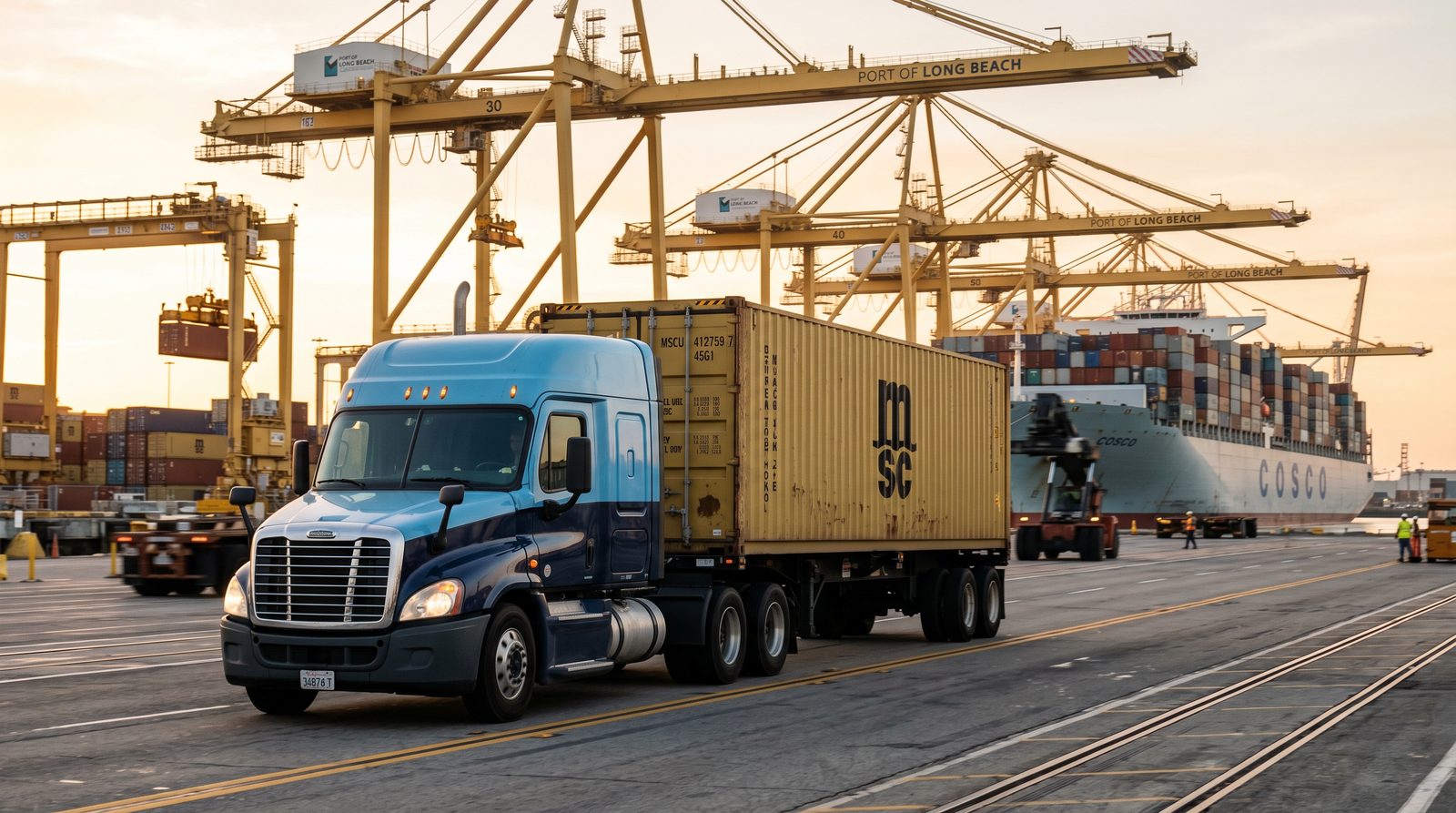
Logistics Experts Serving Port of Los Angeles and Port of Long Beach!

Hazmat Container Drayage at Port of Long Beach

Moving a hazmat container out of the Port of Long Beach is not a standard drayage move. It requires a carrier with hazmat-endorsed drivers, TWIC-cleared personnel, and working knowledge of DOT placard requirements, IMDG Code compliance, and terminal-specific hazmat procedures. One documentation gap or unqualified driver can result in a detention, a port hold, or a regulatory violation that costs far more than the dray itself.

Precision Worldwide Logistics, Inc. is an asset-based drayage company headquartered in La Mirada, CA — approximately 20 minutes from the Port of Long Beach. We have been operating in the LA/LB port complex for 35 years. Our drivers carry TWIC cards and hold hazmat endorsements (H endorsements) on their CDLs. We specialize in Class 9 hazmat drayage, including lithium-ion batteries, EV battery shipments, dry ice, and magnetized materials — the most common hazmat cargo moving through Long Beach today. We also handle select other hazmat classes on a case-by-case basis; contact us to confirm capability for your specific commodity.

If your shipment requires a Long Beach drayage services provider that can legally and safely handle dangerous goods, Precision is built for that work.

Hazmat Classes We Handle at Port of Long Beach

The U.S. Department of Transportation organizes hazardous materials into nine classes. Each class has specific packaging, marking, placarding, and handling requirements. The table below outlines all nine DOT hazmat classes and Precision’s current capability for each.

Class Category Common Examples Precision’s Capability
Class 1 Explosives Ammunition, fireworks, blasting agents Contact us to confirm
Class 2 Gases Compressed gas, liquefied gas, flammable gas, toxic gas Contact us to confirm
Class 3 Flammable Liquids Gasoline, ethanol, acetone, paint Contact us to confirm
Class 4 Flammable Solids Matches, sulfur, metal powders, self-reactive substances Contact us to confirm
Class 5 Oxidizers & Organic Peroxides Ammonium nitrate, hydrogen peroxide, bleach Contact us to confirm
Class 6 Toxic & Infectious Substances Pesticides, biohazardous material, toxic liquids Contact us to confirm
Class 7 Radioactive Material Medical isotopes, industrial gauges, nuclear fuel Contact us to confirm
Class 8 Corrosives Battery acid, hydrochloric acid, sodium hydroxide Contact us to confirm
Class 9 Miscellaneous Hazmat Lithium-ion batteries, EV batteries, dry ice, magnetized materials, elevated-temperature cargo Confirmed capability — our specialty

Important note: Class 9 is Precision’s confirmed area of expertise. For Classes 1 through 8, we handle select shipments on a case-by-case basis. Please contact us with your UN number and commodity description so we can confirm whether we can accept your load before you book.

Class 9 Hazmat Drayage at Long Beach — Our Core Specialty

Class 9 — miscellaneous hazardous materials — is by far the most common hazmat classification moving through the Port of Long Beach. The explosion in global electric vehicle manufacturing and consumer electronics production has made lithium-ion battery shipments a daily constant at LA/LB terminals. Dry ice, used for temperature-sensitive pharmaceutical and food cargo, adds to the volume. Magnetized materials and elevated-temperature cargo round out the Class 9 profile at the port.

Lithium-ion and EV battery shipments are classified under UN 3480 (lithium-ion batteries standalone) and UN 3481 (lithium-ion batteries in or packed with equipment). Large-format EV battery packs for automotive assembly are increasingly routed through Long Beach, and many of these shipments also trigger overweight permitting requirements due to the dense weight of battery modules. For those loads, see our overweight hazmat drayage page.

Dry ice (UN 1845, carbon dioxide solid) is classified as a Class 9 hazmat because it produces CO₂ gas as it sublimates, creating an asphyxiation risk in enclosed spaces. Containers carrying dry ice must be placarded and handled with proper ventilation awareness — our drivers understand the specific protocol.

Magnetized materials (UN 2807) require special attention at air cargo facilities due to interference with navigational instruments, but for ocean container drayage, proper packaging and placarding are the primary compliance requirements our drivers verify on pickup.

Elevated-temperature cargo — including molten sulfur, asphalt, and similar bulk materials transported in a liquid state above 100°C — falls under Class 9 and requires specialized equipment and handling awareness.

Whether your Class 9 container is loaded with consumer electronics batteries, EV packs from an Asian OEM, or pharmaceutical dry ice, Precision’s drivers are trained, endorsed, and ready. If your battery shipment is also overweight, we handle overweight hazmat drayage with proper permitting.

TWIC-Cleared Drivers & Hazmat Endorsements

Two credentials separate a qualified hazmat drayage driver from an unqualified one: the TWIC card and the hazmat endorsement on the CDL.

TWIC (Transportation Worker Identification Credential) is issued by the Transportation Security Administration (TSA) following a federal security threat assessment, including fingerprinting and a criminal background check. TWIC is required for unescorted access to secure areas of maritime facilities — including the terminals at the Port of Long Beach. Without a TWIC card, a driver cannot enter a terminal unescorted to pick up a container. All Precision drivers are TWIC-cleared, meaning they can move through secure terminal zones without an escort, reducing delay and increasing scheduling reliability.

The H endorsement (hazmat endorsement) is a federally mandated certification added to a Commercial Driver’s License that authorizes a driver to transport hazardous materials. Obtaining it requires passing a TSA Security Threat Assessment, a knowledge-based written examination covering federal hazmat regulations, and entry-level driver training (ELDT) from a certified training provider listed on the FMCSA’s Training Provider Registry. Precision’s drivers hold current H endorsements, meaning they are trained on DOT hazmat regulations, handling procedures, and emergency response requirements.

Using a broker to source hazmat drayage capacity means you don’t know whether the actual driver dispatched to your container holds both credentials. As an asset-based carrier, Precision owns its trucks and employs its drivers directly. When you book with us, a Precision driver — TWIC-cleared, hazmat-endorsed, and trained — handles your cargo from terminal gate to final destination.

Placard & IMDG Compliance

Hazmat containers moving through a marine terminal are subject to two overlapping regulatory frameworks: the DOT’s domestic hazmat regulations (49 CFR) and, for ocean-transported cargo, the International Maritime Dangerous Goods (IMDG) Code.

Placard requirements: Any truck transporting hazardous materials in qualifying quantities must display the correct DOT placard on all four sides of the trailer or chassis. Placards must match the hazmat class of the cargo — a mismatch between the placard and the shipping papers is a federal violation. The driver is responsible for confirming that the correct placards are present and properly displayed before departing the terminal. Precision’s drivers are trained to verify placard compliance at pickup, not after the fact.

IMDG Code awareness: The International Maritime Dangerous Goods Code governs how dangerous goods are packaged, labeled, marked, and stowed for ocean transport. While the IMDG Code’s primary obligations fall on the shipper and ocean carrier, a hazmat drayage driver picking up an inbound container must understand the documentation that accompanies IMDG-regulated cargo — including the Dangerous Goods Declaration and any special handling notes — to ensure the container is handled correctly from the moment it leaves the terminal. Our drivers are familiar with IMDG documentation and know what to look for.

If your hazmat container is flagged for a customs examination or a hold, that adds complexity to an already regulated move. We handle customs hold drayage and can coordinate the move once the container is released.

Hazmat at Port of Long Beach Terminals

The Port of Long Beach operates through multiple container terminals, and each has its own procedures for hazmat containers — including designated hazmat lanes, staging areas, and documentation checkpoints. Familiarity with these terminal-specific requirements is not optional; it is what prevents costly delays on a time-sensitive dray.

Precision’s drivers are regularly dispatched to all major Long Beach terminals, including:

Our 35 years of operating in the LA/LB port complex means we understand how each terminal processes hazmat releases, where hazmat staging occurs, and how to work through terminal-specific requirements without burning appointment windows. If your container requires same-day retrieval due to time-sensitive cargo, ask about our same-day hazmat pickup capability.

Why Choose Precision for Hazmat Drayage Long Beach?

Get a Hazmat Drayage Quote for Long Beach

Hazmat quotes require more information than a standard dray. To get an accurate quote quickly, have the following ready when you call or email:

Call us at (714) 690-9344 or use our online quote form. We will respond promptly with capacity confirmation and pricing.

Call (714) 690-9344 for a Hazmat Drayage Quote

Frequently Asked Questions

What hazmat classes do you handle at Port of Long Beach?

Class 9 miscellaneous hazmat is our confirmed core capability — this includes lithium-ion batteries, EV battery packs, dry ice, magnetized materials, and elevated-temperature cargo. These are also the most frequently moved hazmat commodities at the Port of Long Beach. For Classes 1 through 8, we handle select shipments on a case-by-case basis depending on the specific commodity, packaging, and routing. Contact us with your UN number and commodity description and we will confirm capability before you book.

Do your drivers have hazmat endorsements and TWIC cards?

Yes. All Precision drivers who handle hazmat containers carry both a TWIC card and an H endorsement on their CDL. The TWIC card — issued by the TSA after a federal security threat assessment — grants unescorted access to secure maritime facility areas at Port of Long Beach terminals. The hazmat endorsement authorizes the driver to legally transport dangerous goods under DOT regulations. As an asset-based carrier, we employ our drivers directly, so you always know a credentialed Precision driver is on your load — not an unknown third-party operator sourced through a broker.

What is the most common type of hazmat container at Long Beach?

Class 9 hazmat is by far the most common hazmat classification at the Port of Long Beach. The surge in electric vehicle manufacturing and consumer electronics production has made lithium-ion battery shipments (UN 3480 and UN 3481) a high-volume, daily commodity at LA/LB terminals. Dry ice used for pharmaceutical and food cold chain, magnetized materials, and elevated-temperature cargo like molten asphalt also contribute to the Class 9 volume moving through the port. This is why Precision has invested specifically in Class 9 expertise and why we handle these loads routinely, not as exceptions.

How do I get a quote for hazmat drayage at Long Beach?

Call us at (714) 690-9344 or submit a quote request online. To get an accurate quote quickly, have your UN number, DOT hazmat class, container size, pickup terminal, and delivery destination ready. If your container is also overweight, let us know upfront — we handle overweight hazmat drayage with proper permitting and need the gross weight to quote correctly. We respond promptly; hazmat loads with time-sensitive releases get priority handling.

Can you handle overweight hazmat containers?

Yes. Many Class 9 hazmat shipments — particularly large-format EV battery packs and high-density industrial cargo — exceed standard weight limits and require overweight permits. Precision handles overweight hazmat drayage at Port of Long Beach and can coordinate the permit process as part of the move. See our dedicated overweight hazmat drayage page for more detail, or contact us with your container’s gross weight and we will advise on permit requirements and pricing.

What should I have ready before calling for a hazmat drayage quote?

Have the following information available: the UN number of the hazardous material, the DOT hazmat class, the container size (20′, 40′, 40′ HC, or 45′), the Port of Long Beach terminal where the container is available for pickup, the delivery address, and any appointment or delivery window requirements. If the container is overweight, note the gross container weight. If it has been placed on a customs hold, let us know — we handle customs hold drayage and can coordinate the move once CBP releases the container. The more detail you provide upfront, the faster we can confirm capacity and return a quote.

## [JSON-LD SCHEMA]

*(Paste this block inside a `