

Three charges, three different things counted. Demurrage counts the days your container sits inside the terminal after your free time ends. Detention counts the days you keep the ocean carrier’s container after it leaves the terminal. Per diem is usually detention under another name — but on a trucking invoice it often means the chassis instead.
So the first question is not how much this costs. It is which piece of equipment the line is counting, and where that equipment was sitting on those days. Answer that and you know who to call.
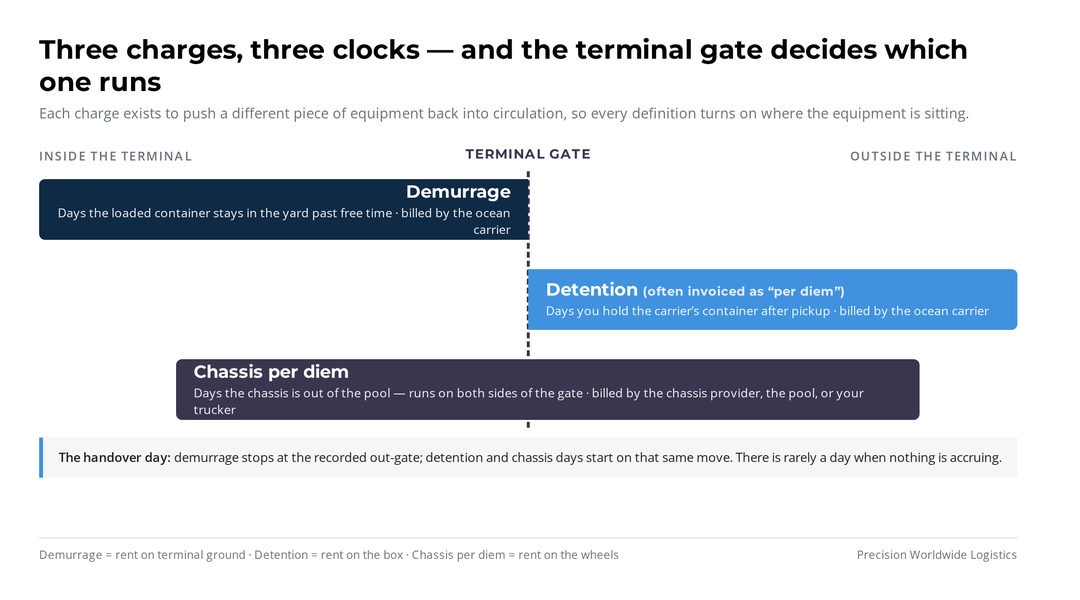
The three clocks are counting three different things
Each charge exists to push a different piece of equipment back into circulation. That is why every definition turns on location, not on fault.
| Charge | What it counts | Where the equipment is | Usually billed by |
|---|---|---|---|
| Demurrage | Days the loaded container stays in the terminal past free time | Inside the terminal gate | Ocean carrier, under its published tariff |
| Detention | Days you hold the carrier’s container after pickup | Outside the terminal gate | Ocean carrier, under its published tariff |
| Chassis per diem | Days the chassis is out of the pool | Wherever the chassis is | Chassis provider, pool, or your trucker |
Free time is the number of days allowed before a charge starts. A chassis is the wheeled steel frame the container rides on — separate equipment, owned by someone else, billed separately.
A shorthand that holds up: demurrage is rent on terminal ground. Detention is rent on the box. Chassis per diem is rent on the wheels. If the pieces do not fit together yet, what drayage is and how a container actually moves walks the journey end to end.
Why “per diem” is the word that causes most of the trouble
Per diem only means “per day”. It is not a defined charge, so two companies use it for two different things.
Most ocean carriers use per diem as their in-house word for detention. Their invoice says per diem; the charge is the daily rate for keeping their container out.
Chassis providers also bill by the day, and they also call it per diem. Your drayage carrier may pass those days through on its own invoice rather than the pool billing you directly.
So per diem on one invoice and per diem on another can be two unrelated charges. Read the equipment number on the line. A container number means detention. A chassis number means chassis rental.
Who sends each bill, and who is allowed to be billed
Demurrage and detention come from the ocean carrier, because the free time and the container both belong to the carrier. Some terminals bill their own storage charges directly in specific situations, so check the letterhead before you decide which company you are arguing with.
Federal Maritime Commission billing rules narrow who may be invoiced. Under 46 CFR Part 541, effective 28 May 2024, a demurrage or detention invoice may go to the party that contracted with the billing party for the ocean transportation or storage, or to the consignee — defined as the ultimate recipient of the cargo, the party to whom final delivery is made. One or the other, not both simultaneously, and not a party with no contractual relationship to the billing carrier.
That matters in practice. If your forwarder booked the ocean freight and a carrier you have never contracted with invoices you directly, you are entitled to ask on what basis.
Chassis days sit outside all of that. If the chassis came from a pool, the pool bills whoever’s account it went out on. If your trucker supplied its own chassis, the days appear on the trucking invoice and there is no third bill to chase.
Where each clock starts, and what sets your last free day
The demurrage clock starts the day after your last free day. That date is calculated from the day the container becomes available for pickup — usually vessel discharge or customs release, whichever is later.
Two details move that date more than importers expect.
First, whether your tariff counts calendar days or working days. On calendar days, a weekend burns two free days while the terminal is closed to you.
Second, whether your free time is combined or separate. Combined free time gives you one pool of days covering both the terminal stay and the return of the empty. Every day lost waiting for an appointment is a day you no longer have to unload and return.
Detention starts when the container leaves the gate, subject to whatever return free time your tariff allows. Chassis per diem starts when the chassis goes out and runs until it comes back, independent of both. Gate and appointment rules are not uniform across the harbour either — how gate and appointment rules differ by Long Beach terminal covers those differences terminal by terminal.
What actually stops each clock — and what only looks like it does
Each clock closes on a recorded event, not on your intention.
- Demurrage stops at the out-gate — the moment the terminal records the container leaving. The gate record is the proof, not your appointment time.
- Detention stops when the empty is accepted and in-gated — recorded as received back at the return location. Arriving at the gate is not the same as being accepted.
- Chassis per diem stops when the chassis reaches a location the provider accepts. Dropping it somewhere convenient does not end the rental.
The gap between those two versions of “returned” is where most disputes live. If a terminal turns your driver away because it is not taking that steamship line’s empties that day, detention keeps running even though you tried.
Get the interchange receipt every time — the document recording the date, time and condition of equipment changing hands. On a refused return, get the reason and the timestamp. That record is the entire basis of a later dispute.
One 40ft container, eleven days: which charge lands on which day
The days below are an example, not a tariff. Your free time comes from your own arrival notice. Assume your tariff allows four free days at the terminal, counted as calendar days, with separate free time for the empty return.
| Day | What happens | Demurrage | Detention | Chassis |
|---|---|---|---|---|
| 1 (Mon) | Container discharged and released. Free time starts. | — | — | — |
| 2–4 | Still in the yard. No appointment yet. | — | — | — |
| 5 (Fri) | Last free day passes. No appointment secured. | Starts | — | — |
| 6–7 (Sat–Sun) | Terminal closed to you. Calendar days still count. | Running | — | — |
| 8 (Mon) | Container out-gates on a chassis. | Stops | Starts | Starts |
| 9–10 | At your dock, waiting on labour to unload. | — | Running | Running |
| 11 | Empty in-gated and accepted, chassis returned. | — | Stops | Stops |
Unit: calendar days. No per-day rates appear here because they come from your carrier’s tariff and the terminal’s schedule, both published and both subject to change. Ask for all three rate schedules in writing when you book.
Look at day 8. One clock closes and two open in the same movement. There is rarely a day when nothing accrues, which is why getting the container out of the port is not the end of your exposure.
The published port fees on that same move can be worked out to the cent, because they are flat. A 40ft container counts as two TEU — twenty-foot equivalent units, the standard measure where one 20ft box is one TEU. On a weekday daytime move, the Traffic Mitigation Fee of $40.63 per TEU, effective 1 August 2026 per PierPass, comes to $81.26. The Clean Truck Fund rate of $10.00 per TEU, as of August 2026 per the Ports of Los Angeles and Long Beach, adds $20.00. That is $101.26 in port fees before a single daily clock is counted.
One thing not to count on: moving the container on an OffPeak shift does not avoid the Traffic Mitigation Fee. It did before 2018, but under OffPeak 2.0 the fee is flat on every non-exempt move regardless of the shift. What is genuinely exempt, per the same WCMTOA announcement, is a short list: empty containers, cargo that transits the Alameda Corridor in a container and is subject to an Alameda Corridor Transportation Authority fee, transshipment cargo, empty chassis and bobtail trucks.
Why day ten costs more than day six
The daily rate is usually not flat. Ocean carrier demurrage tariffs at LA and Long Beach are commonly tiered: the first block of chargeable days sits at one rate, the next block higher, and so on. Find your carrier’s tier boundaries, because they are the shape of your exposure.
The effect is that delay cost is not linear. Two containers five days late cost less between them than one container ten days late, even though the total late days match.
That changes what you do when you are behind on several boxes at once. If two appointments are all you can get and four containers are sitting, pull the ones deepest into the tiers first, not the ones easiest to schedule.
It also changes when the problem turns urgent. A container in its first tier is a cost. A container three tiers deep is a different order of cost, and at that point a prepull earns its keep — moving the container out of the terminal to a yard before you are ready to unload it, purely to close the demurrage clock.
Detention and chassis per diem can be tiered too, and their tiers rarely line up with the demurrage tiers.
What your demurrage or detention invoice has to show you
The Federal Maritime Commission’s demurrage and detention billing rule, 46 CFR Part 541, effective 28 May 2024, sets out what belongs on the invoice. If those fields are missing, you have a procedural argument before you reach the merits.
The invoice has to give you enough to verify the charge yourself: the container number tied to a bill of lading or booking number, the invoice date and due date, the date free time began and the date it ended, the rate applied and the tariff or contract provision it comes from, how the total was calculated, the basis on which you specifically are the party being billed, and a contact point for disputes.
The timing limits are just as useful. A vessel-operating carrier or terminal operator must issue the invoice within 30 calendar days of when the charges last accrued; an NVOCC has 30 calendar days from the invoice it received. You then have at least 30 calendar days to request mitigation, a refund or a waiver, and once you file in time the billing party has 30 calendar days to try to resolve it. Diary the date you receive the invoice, not the date printed on it.
The Commission’s standing position is that these charges exist to move cargo. A charge that accrued during days when retrieval was genuinely impossible is open to challenge on that basis.
The fastest ways to close a clock that is already running
Work the clock that is running, not the one you are angriest about.
For demurrage, the only thing that helps is an out-gate. If appointments are gone, a prepull to a nearby yard closes the terminal clock even though you are not ready for the freight.
For detention, the empty has to be accepted back. If your dock cannot turn the container fast enough, stripping a container at a transload facility moves the cargo onto your own pallets and frees the box in one shift instead of three.
For chassis per diem, check whether you are still holding a chassis you have forgotten about. A chassis left under a loaded container in your yard is on rent the whole time.
One thing to check about your carrier rather than your cargo: California’s Clean Truck Check is active and enforceable, with fines up to $10,000 per day and coverage extending to out-of-state trucks per CARB’s notice of 10 March 2026. A tractor flagged non-compliant can be refused terminal entry, and the demurrage that accrues while you find another truck lands on you.
Customs can hold the clock open too. If your container is pulled for a VACIS scan — an X-ray-style image taken without opening the box — or a tailgate exam at the doors, or a full intensive exam, you pay the exam costs and the demurrage for the days it sits. Related and worth knowing: de minimis treatment has been suspended for all countries since 29 August 2025, per US Customs and Border Protection, so more shipments need a formal entry, and an entry that stalls is a container that cannot be released.
If a container of yours is sitting right now and you cannot tell which of the three clocks is running, call (800) 937-1599, Monday to Friday, 8am to 5pm Pacific. The terminal, the steamship line and the last free day are enough to place it. The reasons containers stall at LA and Long Beach works through the diagnosis if you would rather do it yourself first.

What an asset-based carrier changes about these three clocks
Owning the trucks and the equipment removes handoffs between your last free day and the gate. Precision has run drayage out of La Mirada since 1995, under 30 minutes from both ports, and is registered with the Federal Motor Carrier Safety Administration as CARRIER/IEP — Intermodal Equipment Provider — under USDOT 3201815, active with no out-of-service orders.
Being IEP-registered means the equipment is ours to dispatch rather than borrowed from a pool, so capacity does not evaporate the week everybody needs a chassis. It also means your chassis days can sit on one invoice instead of arriving separately from a company you have no agreement with.
None of that stops a customs hold or invents an appointment that does not exist. What it changes is how many phone calls sit between a released container and a truck underneath it.
Questions importers ask about these three charges
Is per diem the same as detention?
Often, yes. Most ocean carriers use “per diem” as another name for detention — the daily charge for holding their container outside the terminal. But chassis providers also bill a daily charge they call per diem. If a line on your invoice says per diem, look at what equipment it names. A container number means detention. A chassis number means chassis rental.
Can demurrage and detention be charged on the same day?
Not on the same container for the same day, because they cover opposite sides of the terminal gate. Demurrage stops the moment the container out-gates; detention starts from that point. What can overlap is detention and chassis per diem — you can be paying for the container and the chassis under it at the same time.
Who is allowed to bill me for demurrage?
Under the Federal Maritime Commission’s billing rule, 46 CFR Part 541, effective 28 May 2024, a demurrage or detention invoice may go to the party that contracted with the billing party for the ocean transportation or storage, or to the consignee — not to both simultaneously, and not to a party with no contractual relationship to the billing carrier. If an invoice arrives from a company you have no agreement with, ask on what basis you are being billed.
Does the clock stop when I return the empty container?
It stops when the empty is accepted and in-gated, not when your driver arrives at the gate. A turned-away return does not stop detention. Keep the interchange receipt showing the date and time of the in-gate, and keep evidence of any refused return — that record is what a dispute rests on.
What happens if the terminal has no appointments?
You are still exposed to demurrage, but you have grounds to ask for relief. Federal Maritime Commission guidance treats these charges as incentives to move cargo, so a charge that accrued while pickup was impossible is open to challenge. Screenshot the appointment system each day you try, and note the terminal, the date and the time.
What to do next
Pull your arrival notice and find the last free day, then check two things against your tariff: whether it counts calendar days, and whether the free time is combined with the empty return. Those two answers tell you how much room you actually have. If the room is gone, get the container out first and argue the invoice second — a charge can be disputed later, but a day cannot be un-accrued. Our drayage service at the LA and Long Beach ports runs out of La Mirada if you need the truck side handled.