Moving an overweight container out of the Port of Long Beach is not a routine dray. It requires specialized equipment, state-issued permits, a working knowledge of California’s overweight corridor system, and a carrier with the operational experience to execute the move without delays, fines, or violations. For importers, freight brokers, and 3PLs managing heavy cargo — steel coils, paper rolls, stone, industrial machinery, or large-format battery packs — getting this right matters every time.
This guide covers every major aspect of overweight container drayage at POLB: weight thresholds that trigger permit requirements, equipment options, California’s overweight corridor routes, the Caltrans permit process, and how to decide when overweight drayage is the right solution versus transloading. If you need a carrier to handle this move today, call Precision Worldwide Logistics at (714) 690-9344.
What Qualifies as Overweight at Port of Long Beach?
Federal law sets the baseline. Under 23 U.S.C. § 127 and the corresponding Federal Bridge Formula, a standard loaded truck-and-trailer combination operating on interstate highways is limited to:
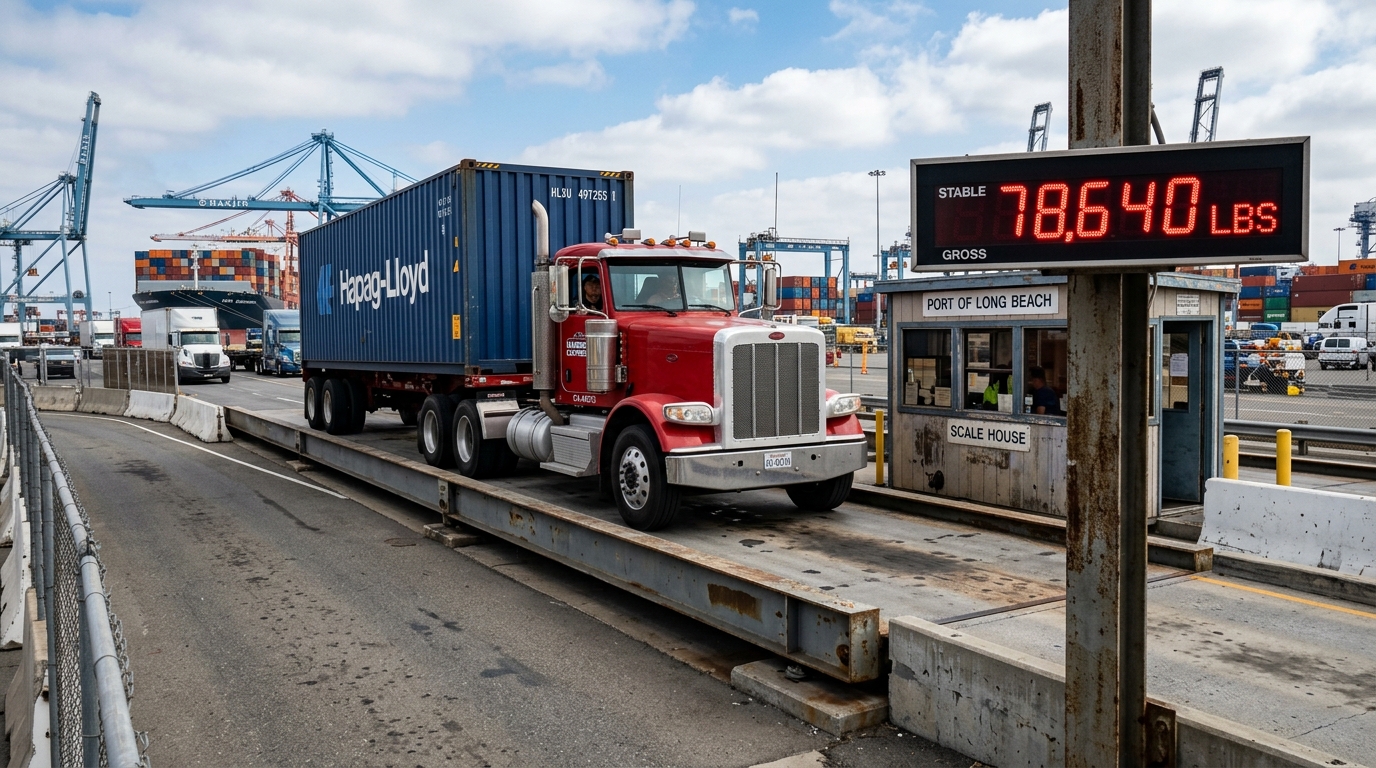
- 80,000 lbs gross vehicle weight (GVW) — the combined weight of tractor, chassis, container, and cargo
- 20,000 lbs on a single axle
- 34,000 lbs on a tandem axle group
- Bridge Formula limits on axle-to-axle spacing throughout the combination
At the Port of Long Beach, a standard 40-foot container on a standard chassis with a loaded tractor typically weighs between 60,000 and 80,000 lbs depending on the cargo density. Heavy commodities — steel, paper, stone, batteries — regularly push containers beyond the federal 80,000 lb threshold.
California adds another layer. The state enforces its own gross weight limits and bridge formula rules under the California Vehicle Code, and state limits on some road segments differ from federal limits. Containers moving from POLB terminals through Long Beach city streets before reaching I-710 must also clear local bridge ratings. Any single load exceeding federal or state thresholds on any applicable axle or GVW calculation requires a Caltrans overweight permit before the truck departs the terminal.
Practical trigger point: If your container’s gross weight — the total weight of the container, cargo, tractor, and chassis — exceeds 80,000 lbs, assume a permit is required. A qualified drayage carrier will calculate the specific permit type based on total weight, axle configuration, and route.
Equipment for Overweight Drayage at POLB
Standard drayage equipment — a two-axle chassis paired with a standard tandem-axle tractor — is designed to operate at or below 80,000 lbs GVW. Once a container exceeds that threshold, distributing the weight across more axles is what keeps axle loads within legal limits. Two equipment configurations handle the majority of overweight container moves at Long Beach.
Triaxle Chassis
A triaxle chassis adds a third axle to the rear of a standard container chassis. The additional axle spreads the container’s weight across more contact points, reducing the per-axle load and allowing the combination to carry higher gross weights while staying within individual axle limits. Triaxle chassis are the most common equipment upgrade for overweight containers in the 80,000–100,000+ lb range. They are standard equipment for steel, paper, and heavy stone containers and are required by most overweight permits issued for loads in this weight band.
Precision Worldwide Logistics owns triaxle chassis as part of its asset base. As an asset-based carrier, we can dispatch triaxle equipment without sourcing it through a third party — a meaningful advantage when timing is tight and chassis availability is constrained at the port.
4-Axle Tractor Configurations
For loads in the 100,000+ lb range — or where bridge formula constraints require even greater axle distribution — a 4-axle tractor (also called a tag axle or pusher axle tractor) may be required in combination with a triaxle chassis. The tag axle on the tractor drops to add a third rear axle on the power unit, giving the overall combination five or more axles to work with across a longer wheelbase. This configuration maximizes weight distribution and is typically required for the heaviest industrial cargo: large transformer units, mining equipment, steel slab shipments, and high-density battery modules for electric vehicles.
Not every carrier operating at Long Beach has access to 4-axle tractors. Confirming your carrier’s actual equipment inventory — not just their quoting capability — before booking a super-heavy load is critical.
California’s Overweight Corridor System and the I-710
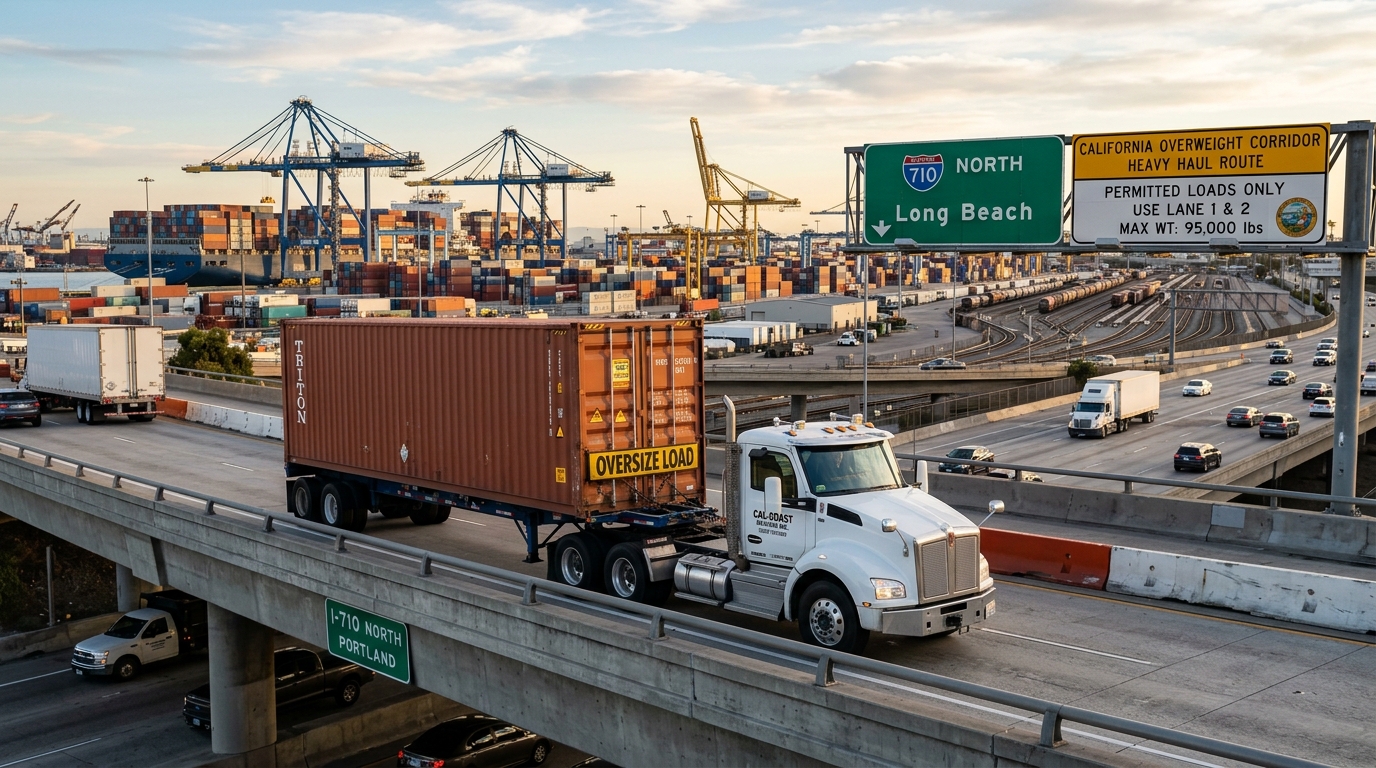
California operates a designated overweight corridor network — specific road segments where Caltrans has pre-authorized higher gross weight limits for permitted oversize/overweight (OS/OW) loads. These corridors exist because the alternative — routing every overweight load over standard roads — would require far more complex engineering analysis and produce far more bridge stress. For Port of Long Beach drayage specifically, one corridor is central to nearly every overweight move.
I-710 (Long Beach Freeway) Overweight Corridor
Interstate 710 — the Long Beach Freeway — runs north from the Port of Long Beach through the cities of Long Beach, Compton, Lynwood, South Gate, Bell, and into the City of Commerce, connecting the port directly to the Inland Empire and the broader Southern California logistics network. The I-710 is specifically engineered and designated as a heavy-haul route for port traffic, and it serves as the primary overweight corridor for POLB drayage moves.
Under California’s overweight corridor permit program, loads moving on the I-710 corridor with a valid Caltrans permit can operate at gross weights exceeding the federal 80,000 lb limit — specific limits depend on axle configuration and permit type, but the corridor enables 97,000 lb to 105,500 lb GVW moves that would require far more complex permitting on standard routes.
Moves that can stay on I-710 from the port terminal to an off-ramp near the destination are the most straightforward to permit and execute. Moves that require departing the corridor — for example, deliveries in cities west of the 710 or on surface streets not part of the corridor network — require additional permit conditions and route analysis. An experienced carrier will know which destinations require corridor-only routing and which require expanded route analysis before the permit is issued.
Local Port Streets and Terminal Access
The I-710 corridor does not begin at the terminal gate. Containers leaving POLB terminals — LBCT at Pier E, ITS at Pier G, PCT at Pier J, TTI at Pier T — must travel through the port’s internal street network to reach the freeway. These local port streets have their own load ratings and routing constraints. A carrier unfamiliar with port street routing can select a path that violates local bridge postings before the load even reaches the I-710. Precision’s 35 years of operating out of Long Beach terminals means this local knowledge is built into every dispatch.
The Caltrans Overweight Permit Process
California overweight permits for container drayage are issued by Caltrans through its Permit Program. Here is how the process works in practice.
Annual vs. Single-Trip Permits
Caltrans issues two primary permit types relevant to port drayage:
- Annual overweight permits: Issued for a fixed axle configuration and specific route corridor, valid for one year. Carriers who move overweight containers regularly — like Precision — obtain annual permits for defined equipment configurations on defined routes. Annual permits reduce per-move lead time dramatically because the route and configuration are pre-approved.
- Single-trip permits: Required for moves that fall outside an annual permit’s scope — unusual routes, non-standard configurations, or loads exceeding the annual permit’s weight ceiling. Single-trip permits require more information and take longer to issue.
What the Carrier Submits
To obtain a permit, the carrier submits to Caltrans the vehicle configuration (tractor type, chassis type, axle spacing, number of axles), the proposed route including all road segments and highways, and the load’s gross weight and axle weight distribution. Caltrans reviews the submission against bridge formula calculations for every structure on the proposed route. If the load passes the analysis, the permit is issued with route conditions — specifying allowed travel hours, required escort vehicle conditions, and any restricted road segments.
Lead Time
Annual permits for standard configurations on established corridors (like the I-710) can be processed quickly — often same-day if the carrier’s configuration is already on file. Single-trip permits for non-standard loads or routes typically require 24–72 hours depending on Caltrans workload. Planning ahead — confirming with your carrier that the permit is in hand before the container is available for pickup — prevents costly port detention charges on heavy cargo.
Common Overweight Cargo Types at Port of Long Beach
Certain commodity categories consistently arrive at POLB in containers that exceed standard weight limits. Understanding which cargo types typically require overweight handling helps importers and freight brokers anticipate permit requirements at the booking stage rather than at the terminal gate.
- Steel products: Steel coils, steel plate, steel billets, and structural steel are among the densest cargo moving through Long Beach. A single 40-foot container loaded with steel coils can approach or exceed 45,000–50,000 kg (approximately 100,000–110,000 lbs) gross, requiring triaxle chassis, tag-axle tractors, and single-trip permits in many cases.
- Paper and newsprint: Paper rolls are compact, heavy, and consistent — a full container of paper rolls will almost always exceed 80,000 lbs GVW. Paper imports from Asia through Long Beach are a significant and regular overweight drayage category.
- Stone and tile: Natural stone, granite slabs, marble, and ceramic tile are high-density building materials that commonly generate overweight containers. The Southern California construction market makes stone imports through POLB a reliable volume category.
- Industrial machinery and equipment: Large machinery components — printing presses, manufacturing equipment, turbines, compressors — can exceed weight limits even in partial containers. These loads frequently require both overweight permitting and oversized load flags or banners depending on configuration.
- EV and lithium-ion batteries: Large-format electric vehicle battery packs and industrial energy storage systems are increasingly moving through Long Beach as domestic EV production scales. These shipments combine Class 9 hazmat classification with high weight density — making them overweight hazmat moves that require both a Caltrans permit and hazmat-endorsed, TWIC-cleared drivers. For these loads, see our hazmat drayage service page.
Overweight Drayage vs. Transloading: How to Decide
When a container arrives overweight, the shipper or consignee has two options: move it as-is with overweight permits, or transload the cargo into two or more standard-weight trucks. Neither option is universally better — the right choice depends on several variables.
When Overweight Drayage Makes More Sense
- The destination is on or near the I-710 corridor. If the delivery point is a warehouse, distribution center, or manufacturing facility directly accessible from the I-710, the permit process is streamlined and the move is operationally straightforward.
- The cargo cannot be split. Some cargo — large machinery components, steel slab sets, single heavy coils — physically cannot be divided between trucks without specialized rigging. Overweight drayage is the only viable option.
- Time is the priority. A single permitted truck moving a container directly from the terminal to the destination is generally faster than a transload operation, which requires the container to be opened, the cargo to be unloaded, reloaded, and re-dispatched on multiple trucks.
- The weight overage is modest. A container that is 5,000–10,000 lbs over the federal limit with a triaxle chassis addition may cost less to move under permit than the labor and dwell time involved in a transload.
When Transloading Makes More Sense
- The destination is off the overweight corridor. If the delivery address is on roads that cannot be permitted for the gross weight — residential delivery zones, cities with restrictive bridge postings, or addresses that require extensive non-corridor routing — transloading at a warehouse near the port and dispatching standard-weight trucks to the final destination is often more cost-effective.
- The weight overage is severe. Loads approaching 120,000+ lbs GVW may require multiple permit tiers, escort vehicles, and travel-hour restrictions that add significant cost and scheduling complexity. At some weight level, transloading into multiple standard trucks becomes simpler.
- The cargo is divisible and time allows. If the cargo type can be split, the consignee has flexibility on delivery timing, and a transload facility near the port is available, transloading may produce lower total cost.
Precision handles both overweight drayage and transloading from our La Mirada facility, approximately 20 minutes from POLB. We can discuss which option fits your specific load, route, and deadline. See our transloading services page for more detail.
How Precision Worldwide Logistics Handles Overweight Container Moves
Precision Worldwide Logistics, Inc. has been operating overweight container drayage at the Port of Long Beach for 35 years. We are headquartered in La Mirada, CA — approximately 20 minutes from the port — and we own our equipment, including triaxle chassis and the tractors required for heavy-haul moves.
Here is how we execute a typical overweight dray from POLB:
- Weight confirmation at booking: We ask for the container gross weight and cargo type at the quoting stage. If you have the weight from the shipping line or the container weight certificate, share it with us. If you do not, we can advise on typical weights for your commodity type and flag the permit requirement upfront.
- Permit coordination: For loads within our annual permit scope on standard I-710 corridor routes, permits are already in hand. For loads outside that scope — unusual weights, non-standard routes, or destinations requiring expanded analysis — we obtain a single-trip permit before scheduling the pickup appointment.
- Equipment dispatch: We dispatch the appropriate equipment for the load — triaxle chassis, tag-axle tractor, or both — based on the gross weight and permit conditions.
- Terminal pickup: Our drivers are TWIC-cleared for unescorted terminal access at all major Long Beach terminals. We pick up overweight containers at LBCT, ITS, PCT, and TTI and confirm the container weight on pickup.
- Permitted move to destination: The load moves on the permitted route with the permitted axle configuration. Our drivers understand the route conditions, travel-hour restrictions, and any escort requirements attached to the permit.
- Delivery and documentation: Delivery confirmation and documentation are provided to you at close of the move.
For overweight hazmat containers — EV batteries and similar cargo — our drivers also carry current hazmat endorsements (H endorsements) on their CDLs, and we manage both the overweight permit and the hazmat documentation requirements on a single coordinated move.
To discuss an overweight container dray from Port of Long Beach, call us at (714) 690-9344 or visit our overweight drayage service page. For standard drayage moves from Long Beach, see our Long Beach drayage hub page.
Frequently Asked Questions: Overweight Container Drayage at Long Beach
What is the weight limit that triggers an overweight permit at Port of Long Beach?
The federal threshold is 80,000 lbs gross vehicle weight — meaning the combined weight of the tractor, chassis, container, and cargo. Any load that pushes the combination above 80,000 lbs GVW on federal highway requires a permit. Specific axle weight limits (20,000 lbs on a single axle, 34,000 lbs on a tandem group) can also trigger permit requirements even if total GVW is below 80,000 lbs. California enforces its own vehicle code weight limits in addition to federal rules. In practice, if your container’s net cargo weight plus tare weight exceeds roughly 44,000–46,000 lbs depending on your tractor and chassis configuration, confirm with your carrier whether a permit is needed before the container is available for pickup.
What equipment is used for overweight containers at POLB?
Two equipment configurations handle most overweight container drayage at Long Beach. A triaxle chassis — which adds a third axle to a standard container chassis — distributes the container’s weight across more axle points, reducing individual axle loads and enabling higher GVW moves. For loads in the 100,000 lb and above range, a tag-axle tractor (which adds a third rear axle on the power unit) may be required in combination with a triaxle chassis. The specific equipment required depends on the container’s gross weight and the axle weight limits specified in the permit. Confirming your carrier actually owns this equipment — rather than relying on spot-market chassis pools — is important when securing capacity for a heavy load.
What is the I-710 overweight corridor and why does it matter for port drayage?
The I-710 (Long Beach Freeway) is California’s designated heavy-haul corridor for port traffic. It connects the Port of Long Beach directly north through the LA metro region toward the Inland Empire. Because the I-710 is engineered for high gross weight traffic, Caltrans permits overweight container moves on this corridor at GVW limits well above the federal 80,000 lb standard — enabling moves in the 97,000–105,500 lb range depending on axle configuration. For destinations accessible from I-710 exits, the permit process is streamlined. For destinations requiring extended off-corridor routing, permit complexity and cost increase. A carrier with long-term POLB experience will understand which destinations require corridor-only routing and plan accordingly.
How far in advance do I need to arrange an overweight permit?
For standard overweight moves on the I-710 corridor with a carrier that holds annual permits for common configurations, the permit can be in hand effectively immediately — sometimes same-day once the load details are confirmed. For non-standard loads or routes outside the annual permit scope, single-trip permits from Caltrans typically require 24–72 hours depending on the complexity of the route analysis and current Caltrans processing times. The key is to notify your carrier about the overweight status at the booking stage — not after the container is available for pickup. Late identification of an overweight condition when the container is already at the terminal can result in port detention charges while the permit is processed.
Can overweight containers also be hazmat?
Yes — and this is increasingly common. Large-format EV battery packs (classified as Class 9 hazmat under UN 3480 and UN 3481) are among the heaviest containers moving through Long Beach today. These loads require both a Caltrans overweight permit and a driver with a hazmat endorsement (H endorsement) on their CDL and a current TWIC card. Not every carrier that handles overweight drayage is also qualified to handle hazmat — and vice versa. Precision handles overweight hazmat drayage at Port of Long Beach, combining permitted heavy-haul moves with credentialed hazmat drivers on a single coordinated move. Contact us to confirm capability for your specific commodity and weight.