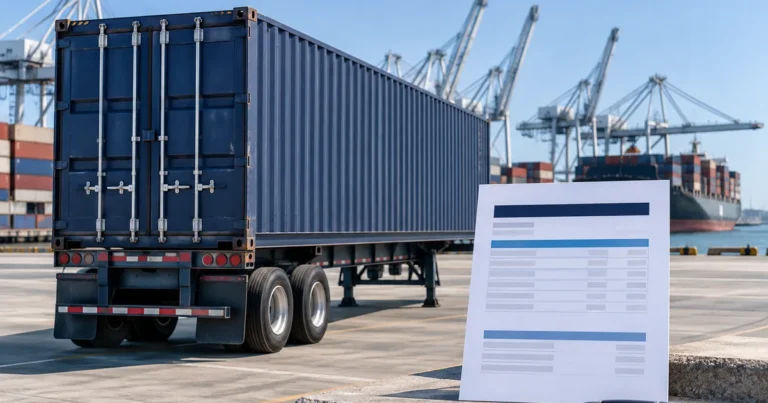
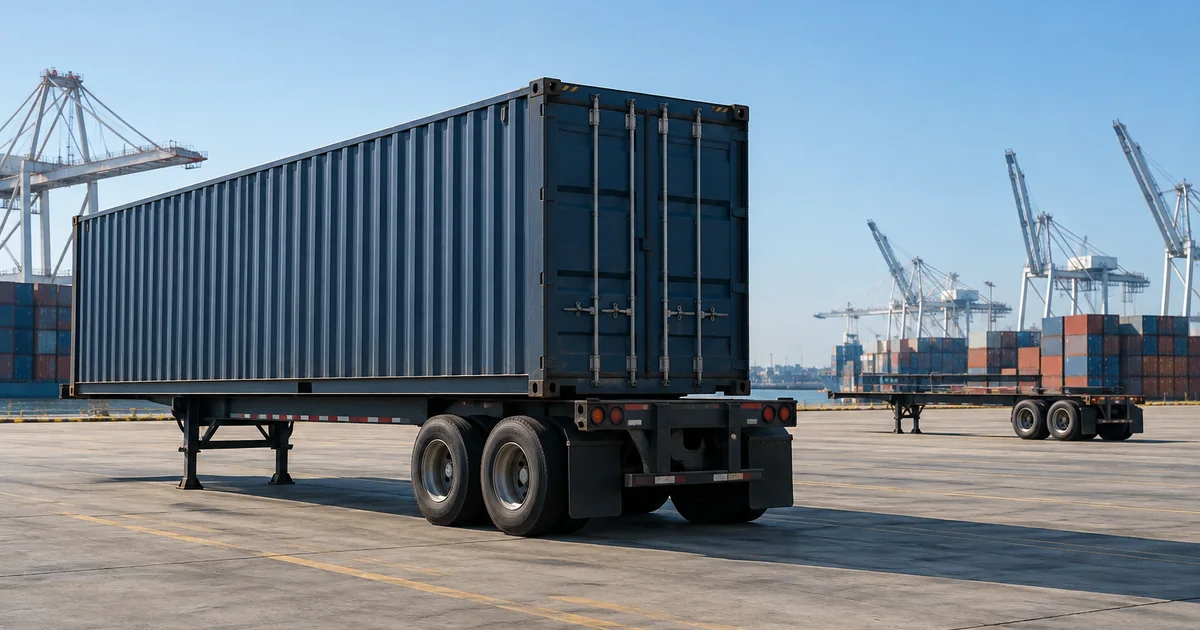
A chassis is the wheeled frame that carries a shipping container on the road. A chassis split can occur when the container and the chassis needed for the move are at different locations, requiring extra handling or a separate trip. Chassis per diem is a daily equipment-use charge under the applicable interchange or provider terms. Check which equipment and clock an invoice line refers to before paying it.
The chassis and container have separate records
A container cannot travel on the road by itself. It is secured to a chassis, which has its own equipment number, provider, interchange record, and return requirements. The shipping line’s container clock and a chassis provider’s equipment clock are not automatically the same.
The Federal Motor Carrier Safety Administration defines an intermodal equipment provider (IEP) as a person or entity that makes intermodal equipment available to motor carriers or has specified contractual responsibility for that equipment. That status does not, by itself, tell you which chassis is assigned to a particular load, how many days are free, or what a customer must pay. Those details come from the move and the relevant agreements.
What a chassis split means
In a straightforward move, the truck can obtain the chassis and container at the planned location. A split can arise when the chassis needed for the move is somewhere else, or when the container and chassis must be handled separately. The driver or carrier may need an extra trip or additional coordination before the container can leave.
The term does not identify one universal service or price. Ask the carrier to explain what happened on your move: where the container was, where the chassis was, what extra handling occurred, and which written term allows a separate charge. A split fee should correspond to an actual service or agreed charge, not just an unexplained label.
For a Long Beach drayage move, terminal, chassis source, and appointment details can affect the sequence. Do not assume that every container at the Port of Long Beach uses the same chassis arrangement.
Chassis per diem follows equipment terms
“Per diem” means per day. A chassis provider or interchange agreement may allow free use for a specified period and charge for additional days. The start and end points, free time, rate, responsible party, and billing method depend on the applicable terms. There is no single free-time period that can safely be assumed for every chassis.
Before dispatch, ask which chassis is assigned, when the interchange clock starts, where it must be returned, what counts as an accepted return, and where the current terms are recorded. After the move, compare the invoice with the equipment interchange receipt or other provider record. That evidence helps establish the chassis number and the dates it was out.
Do not treat a chassis daily charge as container detention. Container detention is typically tied to a shipping line’s equipment being outside the terminal beyond its free time. Chassis per diem concerns the chassis. The billing source and clock may differ, even when both appear on the same invoice.
| Charge | Equipment or location | What to verify |
|---|---|---|
| Demurrage | Container inside a marine terminal | Applicable free-time terms and terminal or carrier record |
| Detention | Shipping-line container outside the terminal | Container return date and the line’s terms |
| Chassis per diem | Chassis identified by its equipment number | Interchange record, provider terms, and accepted return |
Labels and contract terms can vary. Use the records and governing terms for the specific move, not the table alone, to decide whether a charge is correct. Our guide to demurrage, detention and per diem explains how to check these time-based charges separately.
Find the source of an unexpected charge
If you see a chassis split or daily equipment charge, gather the records before debating the amount:
- Match the invoice to the container number, chassis number, terminal, and move date.
- Get the dispatch record and equipment interchange receipt showing pickup and return events.
- Ask which provider or agreement sets the free time and rate.
- Compare the billed dates and units with that agreement.
- Request a written explanation if the records do not match the invoice.
A daily charge may continue until the chassis provider accepts the return, not simply until the truck reaches a terminal or yard. Confirm the applicable return procedure and keep proof of the accepted in-gate or interchange. If a return is refused, record the reason and notify the party controlling the equipment arrangement.
Reduce avoidable chassis time without assuming it is all in your control
You can help the move by confirming the delivery appointment, receiving hours, and empty-return plan before the container is dispatched. A warehouse that is not ready or a late change to the return location can keep equipment out longer. Ask the carrier when the chassis must be released and who is responsible for arranging the return.
A carrier that provides or controls chassis may be able to coordinate equipment differently from one relying on another provider, but that does not guarantee a chassis will be available at a specific terminal or prevent every split. Ask what is planned for this container and what happens if the planned chassis is not available.
A “street turn” and a dual transaction are also different from a chassis split. A street turn generally transfers an empty container from one shipper to another without first returning it to a terminal. A dual transaction usually combines a terminal drop-off and pickup during one visit. Both depend on terminal, carrier, and shipping-line rules, and neither should be assumed to be possible for a particular load.
For more on equipment choices, see our guide to choosing a drayage chassis. Our port-fee guides cover separate charges that can appear alongside chassis charges.
Frequently asked questions
What is a chassis split in drayage?
A chassis split describes a move where the chassis and container are not together at the planned pickup or handling point, so the carrier must coordinate or make an additional trip. The label alone does not state the exact work or the price. Ask where each item was, what additional service occurred, and which written term supports the charge.
Who pays chassis per diem?
The responsible party depends on the equipment interchange, provider agreement, and the customer-carrier contract. A provider may bill the party that has the chassis checked out, and the contract may determine whether another party is charged. Ask for the chassis number, interchange dates, applicable schedule, and written billing term rather than assuming every carrier passes the charge through in the same way.
How many free days do I get for a chassis?
There is no universal number that applies to every provider and move. Free time, the event that starts the clock, and the accepted return point are set by the applicable terms. Ask for those details before dispatch and compare any later daily charge with the equipment record and agreement.
Is chassis per diem the same as container detention?
No. Chassis per diem applies to use of the chassis under its equipment terms. Container detention is generally tied to a shipping line’s container remaining outside the terminal beyond free time. They can run on separate clocks and have different billing parties. Verify the equipment number, dates, and source of each invoice line.
If a chassis charge is unclear, ask the carrier to show the assigned equipment, interchange events, and written rate term. For a move through Long Beach, you can request a drayage quote.